Best Apps to Reduce Cravings and Food Noise (2026)
Disclosure: IntakeAI is made by the team that publishes this guide. We include it where it genuinely fits, say where other apps are a better choice, and do not accept payment from any app listed. Features and prices were checked against official websites and app store listings on 10 October 2026 and can change.

What is the best app to reduce cravings and food noise?
The best app for reducing cravings through what you eat is IntakeAI: it scores every meal 0–10 for fullness from the factors research links with satiety, gives two tips to make each meal more filling, and charts your daily trend. Noom, Lose It!'s GLP-1 support and MacroFactor suit narrower needs. No app has been shown in trials to reduce cravings, so treat any score as a guide, not a guarantee.
IntakeAI's six factors are protein, fiber, calorie density, hyper-palatability, satiety nutrients and processing level. The idea: the more of your meals score as filling, the less room cravings get.
Key takeaways
- IntakeAI is the only app we found that scores each meal for fullness and tells you how to make it more filling. Like every app, it has not been trial-tested for cravings.
- Noom's green, yellow and orange food colors, based on calorie density, are the closest alternative; they rate single foods, not whole meals.
- GLP-1 medications such as semaglutide have the strongest trial evidence for fewer cravings, but they are prescription drugs, not something an app replaces.
- No app measures "food noise" directly. What people did after a craving predicted weight change in a survey of 2,932 dieters, so a short craving log is worth keeping.
Quick picks
- Best overall for reducing cravings through what you eat: IntakeAI — every meal scored 0–10 for fullness, two tips to make it more filling, and a daily fullness trend.
- Best for a simple food-by-food guide with coaching: Noom — green, yellow and orange labels based on calorie density, plus behavior lessons.
- Best if you take GLP-1 medication: Lose It! — GLP-1 support that shows estimated medication levels next to your eating.
- Best if numbers feel stressful: MacroFactor — no warnings, red numbers or shaming when you go over.
- Best for a do-it-yourself craving rating: Cronometer — free notes, and custom biometrics on Gold you can use as a 0–10 craving score.
- Best for logging mood alongside meals: Yazio — a mood tracker on Pro.
- Best free option: a notes-app or paper craving log — costs nothing and works alongside any tracker.
What can an app actually measure about cravings and food noise?
"Food noise" is an informal term for constant, intrusive thoughts about food. A 2023 narrative review led by Penn State researchers notes the term spread through anecdotal reports from people taking GLP-1 medications such as semaglutide, and proposes a model linking it to food cue reactivity: how strongly you respond to the sight, smell or thought of food. A phone can't sense that, but apps can help with three measurable pieces, and the first is the one most within your control. For the psychology behind food noise, see how to stop thinking about food all the time.
| What you track | What the research shows | Apps that help |
|---|---|---|
| How filling a meal is likely to be | In equal 240 kcal servings of 38 foods, the most filling (boiled potatoes, 323%) was seven times more filling than the least (croissant, 47%); protein, fiber and water raised satiety, fat lowered it | IntakeAI (per meal), Noom (per food) |
| Craving episodes and food thoughts | In a 7-day study of 61 adults, stronger cravings and more snack-related thoughts went with more snacking; 86% of snacks were high-calorie | Any app with notes, custom fields or a mood log; a paper log |
| What you did after a craving | In 2,932 people in a weight program, eating in response to cravings predicted weight change over 7 weeks | A craving log; no app tracks this automatically |
Sources: the satiety index study (11–13 people per food), an experience-sampling study and an online survey (97% women). None tested an app.
Which apps have a cravings or fullness feature?
MyFitnessPal, FatSecret, Cal AI and SnapCalorie have no satiety or cravings feature that we could find. Prices are US prices as of October 2026.
| App | Fullness / craving feature | Rates | Based on | Free option | US price (Oct 2026) |
|---|---|---|---|---|---|
| IntakeAI | Cravings control score, 0–10 | Each meal and each day | Six nutrition factors | No (free trial on annual plan) | Subscription (prices shown in app/store) |
| Noom | Green / yellow / orange colors | Each food | Mainly calorie density | Limited (US green-food logging) | $70/mo, $209/yr |
| Lose It! | None; GLP-1 support | — | Estimated medication levels | Tier not stated | $79.99/yr |
| MacroFactor | None; non-judgmental design | — | — | No (7-day trial) | $11.99/mo, $71.99/yr |
| Cronometer | None; notes and custom biometrics | — | Your own entries | Yes (notes); custom biometrics on Gold | Gold $10.99/mo or $59.99/yr |
| Yazio | None; mood tracker | — | Your own entries | Mood tracker is Pro | 12 months $47.90 |
| Lifesum | None; Life Score rates overall diet quality | Your week | Diet quality | Yes, limited | 1 year $99.99–$119.99 |
Track calories & nutrients fast


The best apps to reduce cravings, in detail
IntakeAI: best overall for reducing cravings through what you eat
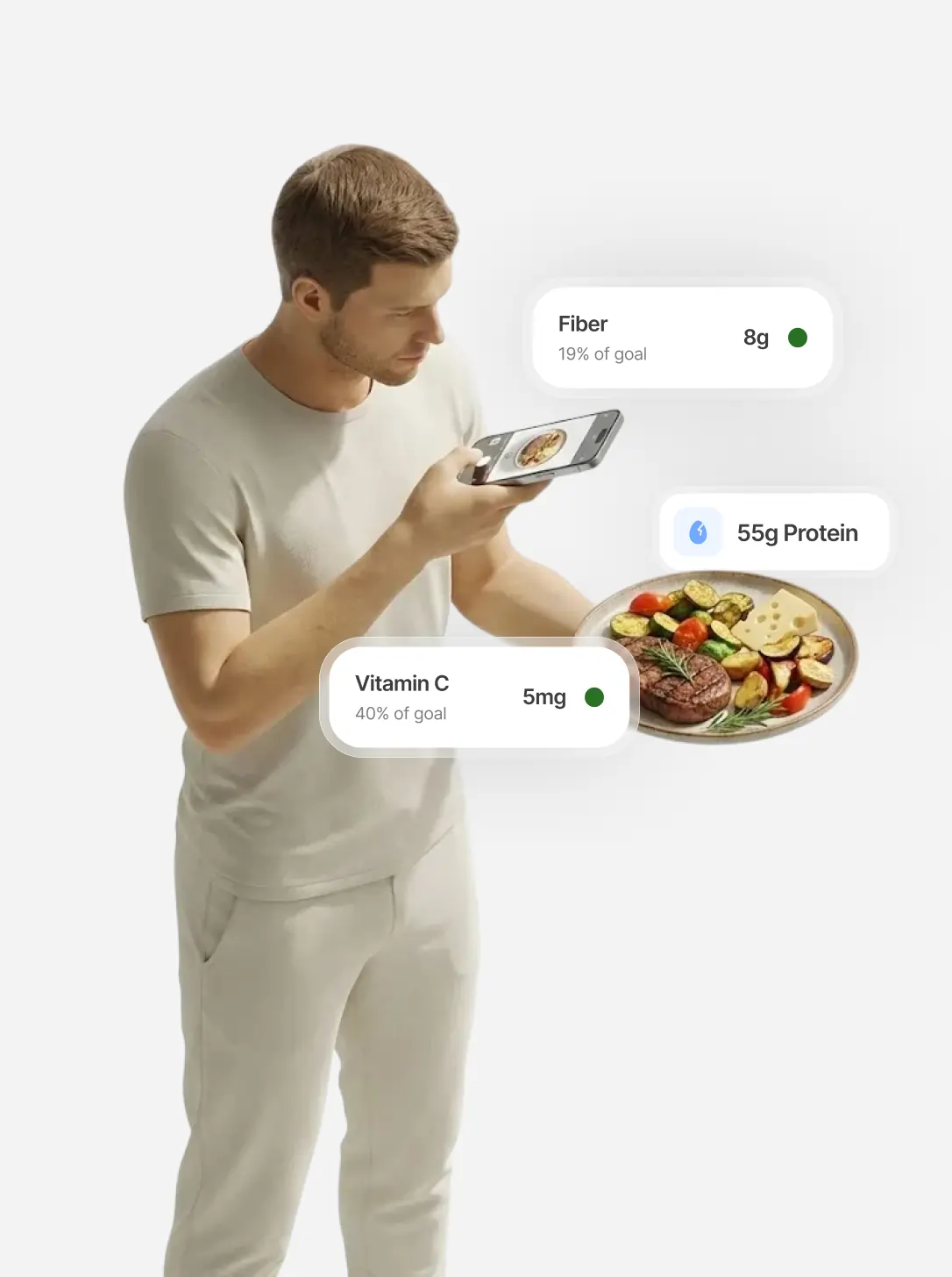
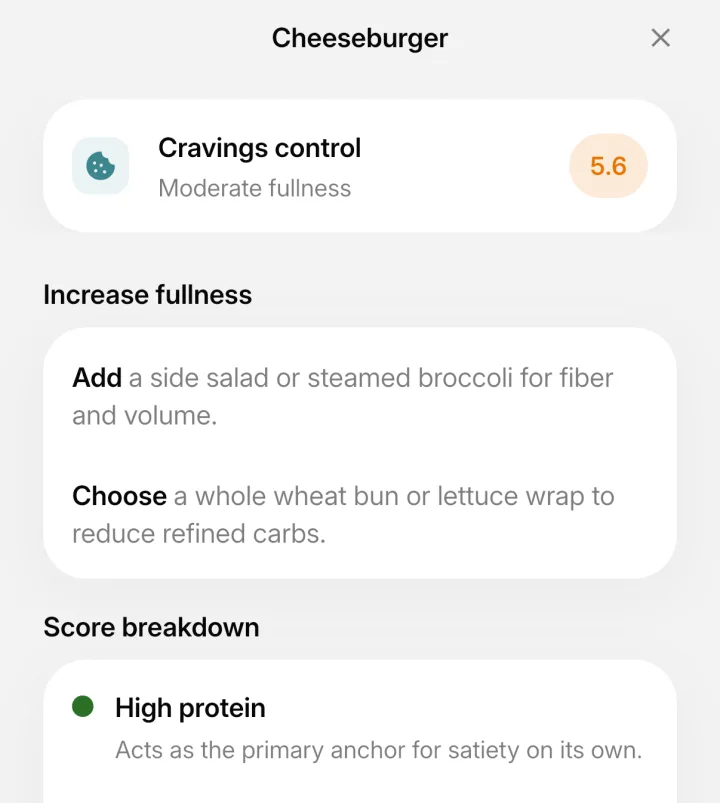
IntakeAI is an iPhone and Android nutrition app designed to help you reduce cravings. It estimates calories, macros and 50+ nutrients from a meal photo, barcode, nutrition label or text description, then gives the meal a Cravings control score from 0 to 10. The score is a transparent formula, not an AI guess. It combines six factors, each tied to appetite research:
- Protein — in a 12-week trial of 27 men on a 750 kcal/day deficit, a 25%-protein diet gave more fullness and less late-night food preoccupation than 14%.
- Fiber and calorie density — fiber tracked with satiety in the satiety index study, and lower-density meals tend to reduce intake, according to a review by Barbara Rolls.
- Hyper-palatability — flags fat-plus-sugar and fat- or carb-plus-salt combinations, similar to a 2019 definition that classed 62% of foods in a US database as hyper-palatable.
- Satiety nutrients — potassium, magnesium, calcium, zinc, iron and B12.
- Processing level — in a 2-week NIH inpatient trial of 20 adults, people ate about 500 kcal a day more on an ultra-processed diet.
Meals scoring below 4 are labeled "Likely to trigger cravings," 4–7 "Moderate fullness" and 7+ "Likely to keep you fuller," with two "Increase fullness" tips per meal. A daily fullness score and chart show whether your meals are trending more filling. Our guide to building a weight loss meal that controls cravings explains each factor with examples.
Limits: the score is an estimate that has not been tested in a trial as a way to reduce cravings, and photo estimates can be off on portions and hidden oils (you can edit them). It needs a paid subscription with no free tier, has no voice logging or AI coach, and does not show the score if your goal is weight gain.
Noom: best for a simple food-by-food guide with coaching
Noom labels foods green, yellow or orange, mainly by calorie density, a system it says is designed to help you feel full. For solid foods, green is under 1.0 calories per gram, yellow 1.0–2.4 and orange above 2.4. Some adjustments go beyond density: artificially sweetened drinks are yellow even at zero calories, which Noom attributes to low satiety and high processing. Lessons and optional coaching add behavioral support. Because it rates single foods mainly on density, it won't tell you whether a whole meal has enough protein. Full logging costs $70/month or $209/year; the free tier, US only, counts green foods.
Lose It!: best if you take GLP-1 medication
Lose It!'s App Store listing describes GLP-1 support that shows estimated medication levels and how those phases may align with your hunger and eating habits. If you are on semaglutide or a similar drug, that helps you see when appetite tends to return. It isn't a meal fullness score, and dosing questions belong with your prescriber. Photo, barcode and nutrient tracking are Premium at $79.99 a year, with no monthly plan.
MacroFactor: best if numbers feel stressful
For some people, red numbers and "over budget" warnings feed the noise. MacroFactor's listing says it shows no warnings, red numbers or shaming when you go over targets, and its algorithm adjusts your targets at weekly check-ins. It has no cravings feature and no free tier ($11.99/month or $71.99/year after a 7-day trial).
Cronometer: best for a do-it-yourself craving rating
Cronometer has no fullness score, but its free Basic plan lets you log notes alongside food. Gold ($10.99/month or $59.99/year) adds custom biometrics, which you could set up as a daily 0–10 craving rating, and timestamps for spotting time-of-day patterns. It suits people who also want deep micronutrient data; see our nutrient tracker comparison.
Yazio: best for logging mood alongside meals
If cravings follow stress or low mood, seeing both in one place helps. Yazio Pro includes a mood tracker and a "Smart Food Rating" for nutritional value, which is not a satiety score. The US App Store lists a 12-month plan at $47.90; the free tier shows ads.
A notes app or paper log: best free option
A plain log captures what no app measures automatically: when the craving hit, how strong it was and what you did. Our guide to tracking food cravings and learning your triggers has a copyable template. To track cravings with any app, rate each 0–10, note what you did, and weekly check whether the strongest followed low-scoring meals.
What has the strongest evidence for reducing food noise?
Honestly, prescription GLP-1 medications, not apps. In a 12-week crossover trial of 30 adults with obesity, weekly semaglutide (1.0 mg) cut energy intake across self-selected meals by 24% versus placebo and was linked to less hunger, fewer food cravings and better control of eating. In the 2-year STEP 5 trial, a subgroup of 174 adults on semaglutide 2.4 mg or placebo answered a control-of-eating questionnaire; craving control scores improved on the drug at 20, 52 and 104 weeks. Both trials were funded by the drug's maker, Novo Nordisk.
These are medical treatments with side effects and eligibility criteria, prescribed by a doctor. An app is not a substitute, and neither is IntakeAI. For non-drug strategies, see how to stop thinking about food all the time.
How to choose
- Want meals that keep cravings down? IntakeAI for a per-meal fullness score and tips, or Noom for a simpler food-color guide with coaching.
- On a GLP-1 medication? Lose It!'s GLP-1 support, with advice from your prescriber.
- Feel judged by numbers? MacroFactor.
- Cravings tied to mood? Yazio's mood tracker, or any tracker plus a log.
- Want to spend nothing? Cronometer Basic plus notes, or a paper log.
For the bigger picture across calories and nutrients, see our comparison of the best apps to reduce cravings and track calories and nutrients, and for strategies beyond apps, how to reduce food cravings and food noise. If logging itself puts you off, the best diet apps for people who hate logging food focus on low-effort methods.
How we compared these apps
We checked features and prices on each app's official website, help center, and US App Store and Google Play listings on 10 October 2026, and looked specifically for any feature that rates fullness, satiety or cravings. We did not run hands-on tests. None of the cited research tested a specific app. We make IntakeAI, so we have listed its limits next to its strengths.
Frequently asked questions
Is there an app that tracks food noise?
No app measures food noise directly, because it is an informal term for intrusive food thoughts, not a clinical measurement. The strongest trial evidence for quieter food noise is for prescription GLP-1 medications. You can rate food thoughts yourself in a notes field or paper log and compare them with a meal fullness estimate such as IntakeAI's Cravings control score.
What is the best app to reduce cravings?
IntakeAI is our top pick: it scores every meal 0–10 for fullness using protein, fiber, calorie density and three other factors, and gives two tips to make each meal more filling. Noom is an alternative that colors foods by calorie density. No app has been shown in trials to reduce cravings, so use the score as a guide.
Does tracking cravings help you lose weight?
It can help you spot patterns. In a survey of 2,932 people in a weight management program, eating in response to cravings predicted weight change over 7 weeks, which suggests logging what you do after a craving is the most useful part.
How does IntakeAI's Cravings control score work?
It is a transparent formula, not an AI guess, combining six factors for each meal: protein, fiber, calorie density, hyper-palatability, satiety nutrients and processing level. Scores below 4 are labeled likely to trigger cravings, 4 to 7 moderate fullness, and 7 or more likely to keep you fuller. It is an estimate to guide your choices.
Should I use a cravings app if I binge eat?
If you binge regularly, feel out of control around food or tracking makes you anxious, speak to a doctor or an eating disorder specialist before using any tracking app.
Related guides
Best Apps to Reduce Cravings and Track Calories and Nutrients (2026)
13 food trackers compared on cravings features, nutrients, logging methods and price.
READ MORE
Best Diet Apps for People Who Hate Logging Food
The lowest-effort ways to log meals, from photos and barcodes to saved meals.
READ MORE
Best Way to Track Food Cravings and Learn Your Triggers
A craving log template and a 2-week method for finding what sets your cravings off.
READ MOREBuild meals designed to keep cravings down
Log a meal by photo, barcode or text and IntakeAI estimates its Cravings control score from protein, fiber, calorie density and three other factors, with two tips to make it more filling.
Sources
- Hayashi D et al. (2023). What is food noise? A conceptual model of food cue reactivity. Nutrients. PubMed
- Blundell J et al. (2017). Effects of once-weekly semaglutide on appetite, energy intake, control of eating, food preference and body weight in subjects with obesity. Diabetes Obes Metab. PubMed
- Wharton S et al. (2023). Two-year effect of semaglutide 2.4 mg on control of eating in adults with overweight/obesity: STEP 5. Obesity. PubMed
- Holt SH et al. (1995). A satiety index of common foods. Eur J Clin Nutr. PubMed
- Richard A et al. (2017). Food cravings in everyday life: an EMA study on snack-related thoughts, cravings, and consumption. Appetite. PubMed
- Smithson EF, Hill AJ (2017). It is not how much you crave but what you do with it that counts: behavioural responses to food craving during weight management. Eur J Clin Nutr. PubMed
- Leidy HJ et al. (2011). The effects of consuming frequent, higher protein meals on appetite and satiety during weight loss in overweight/obese men. Obesity. PubMed
- Rolls BJ (2009). The relationship between dietary energy density and energy intake. Physiol Behav. PubMed
- Fazzino TL et al. (2019). Hyper-palatable foods: development of a quantitative definition and application to the US food system database. Obesity. PubMed
- Hall KD et al. (2019). Ultra-processed diets cause excess calorie intake and weight gain: an inpatient randomized controlled trial of ad libitum food intake. Cell Metab. PubMed
- Noom. How Noom's food color system works. Noom support; Free features in the Noom app. Noom support; How much does Noom cost? Noom blog
- Cronometer. Gold and Basic features. cronometer.com
- Yazio. How does Yazio Pro support my goals? Yazio help; App Store listing. App Store
- Lose It! App Store listing. App Store; Membership tiers and pricing. Lose It! help
- MacroFactor. App Store listing. App Store. Lifesum. App Store listing. App Store
This article is for general education and is not medical advice. If you have a medical condition, an eating disorder, are pregnant, or take medication, speak to a doctor or registered dietitian before changing your diet. IntakeAI's nutrition figures and scores are estimates to guide your choices.