Best Way to Track Food Cravings and Learn Your Triggers

What is the best way to track food cravings?
The best way to track food cravings is a short log filled in the moment an urge hits: the time, what you want, how strong it is (0–10), how hungry you are, where you are, how you feel and what you did. Keep it for 14 days, then sort entries by time, trigger and the meal before. Two weeks is usually long enough to capture weekdays, weekends and a few bad nights' sleep, and short enough that you will actually finish it.
The goal is not to judge yourself or to stop every craving. It is to turn a vague feeling — "I always want sugar in the evenings" — into something specific you can change, such as "8 of my 11 strongest cravings came after lunches with almost no protein, on days I slept under 6 hours".
Key takeaways
- Log cravings in real time, not at the end of the day: research on cravings uses in-the-moment reports because memory and questionnaires can miss daily patterns.
- In a 7-day real-time study of 61 people, stronger cravings went with more snacking, and 86% of reported snacks were high-calorie.
- Frequency beats effort: in a 24-week program of 142 people, those who lost 5% or more opened their food journal about 2.4 times a day vs 1.6, while minutes spent did not differ.
- Record what you did after each craving — in one survey of 2,932 dieters, eating in response to cravings predicted weight change more than how often cravings occurred.
Why log cravings at all?
Self-monitoring is one of the most consistent habits in successful weight management. A systematic review of 22 studies consistently found a significant association between self-monitoring and weight loss, though the authors rated the evidence weak because most studies relied on self-report and mostly involved white women. Most of that research tracked food, not cravings, but the principle is the same: you cannot change a pattern you cannot see.
Cravings are particularly easy to misremember. Researchers who study them in daily life use ecological momentary assessment — short reports made several times a day — precisely because lab tasks and one-off questionnaires may not reflect real behavior. In one EMA study, 61 participants reported snack thoughts, craving intensity and snacking five times a day for a week. Higher craving intensity was linked to more snacking, more snack-related thoughts were linked to more frequent snacking, and chocolate was the most common snack. A larger experience-sampling study of 205 adults collected 7,827 desire reports in a week and found that situations — including who you are with — shaped whether people resisted. A log helps you see your version of those situations.
A craving log template you can copy
Use one row per craving, including ones you resisted. Fill in the first eight columns when the urge hits, and the last two about 15 minutes later. The two rows below are an illustrative example, not real data.
| Time | Craving for | Strength (0–10) | Hunger (0–10) | Last meal & how long ago | Where / with whom | Mood or state | Sleep last night | What I did | Strength after 15 min |
|---|---|---|---|---|---|---|---|---|---|
| Tue 15:40 | Chocolate bar | 7 | 4 | Salad, no protein – 3.5 h | Desk, alone | Bored, tired | 5.5 h | Walked to kitchen, had yogurt | 3 |
| Tue 21:15 | Chips | 6 | 2 | Pasta with chicken – 2 h | Sofa, TV | Relaxed, habit | 5.5 h | Ate half a share bag | – |
How to fill in each column
- Strength and hunger: rating them separately is the key move. A strength of 7 with a hunger of 2 is a very different problem from a 7 with a hunger of 8. If you are unsure how to rate hunger, use the signs in our guide to cravings vs hunger.
- Last meal: note what it was and roughly how much protein and fiber it had, plus the hours since you ate.
- Mood or state: keep a short fixed list so entries are comparable — hungry, tired, stressed, bored, sad, celebrating, habit, saw or smelled food.
- Sleep: one number per day is enough. Short sleep is linked to higher next-day intake in a meta-analysis of sleep-restriction studies.
- What I did, and strength after 15 minutes: this shows which responses actually work for you.
The 2-week method
- Days 1–3: observe only. Do not try to change anything. Log every craving above about 4/10, and every time you eat something you had not planned.
- Days 1–14: log within five minutes. Keep the log where you crave — a note pinned on your phone's home screen, or a card in your bag. A delayed entry tends to be a guess.
- Every evening: one-minute check. Add your sleep number, fill in any gaps, and write down your meals for the day if you are not already logging them.
- Day 7: first review. Count entries and look for the obvious: the most common time block and the most common state.
- Days 8–14: test one change. Pick the biggest pattern and try a single experiment against it (see the table below). Keep logging the same way.
- Day 14: full analysis. Compare week one with week two using the steps in the next section.
Logging often seems to matter more than logging at length. In a 24-week online weight-loss program of 142 people, time spent self-monitoring fell from 23.2 minutes a day in month 1 to 14.6 in month 6. Among those still logging, minutes spent did not differ by weight loss, but those losing at least 5% of their weight opened the journal more often (2.4 vs 1.6 times a day). Quick, frequent entries beat long ones at the end of the day.
Track calories & nutrients fast


How to analyze your log and find triggers
After 14 days you will typically have a few dozen entries. Work through them in this order:
- Sort by time. Group entries into blocks: morning, lunch to 3pm, 3–6pm, 6–9pm, after 9pm. Cravings often cluster in the late afternoon and early evening, but your own peak is what matters.
- Split by hunger. Count cravings with a hunger rating of 6 or more. If they are a large share, the main fix is meals, not willpower.
- Check the meal before. For your ten strongest cravings, look at the meal that preceded them. Was it small, low in protein or fiber, or more than four hours earlier?
- Tally states. Which of your fixed labels comes up most — tired, stressed, bored, habit, cue?
- Compare sleep. Average your craving count on days after under 6 hours of sleep vs days after 7 or more.
- Score your responses. For each type of response (waited, swapped, ate a planned portion, ate freely), average the "strength after 15 minutes".
That last step matters. A survey of 2,932 people in a commercial weight-loss program found that eating in response to cravings predicted weight change, and the authors concluded it is the behavior after a craving, rather than its frequency or intensity, that counts. Your log tells you which behaviors work for you.
Common patterns and an experiment to try
| Pattern in your log | Likely trigger | One-week experiment |
|---|---|---|
| Hunger 6+ and last meal 4+ hours ago | Under-eating or long gaps | Add a planned protein snack before the usual time |
| Strong cravings after low-protein lunches | Meal not filling enough | Add 25–30 g protein and a vegetable to lunch |
| Same place and time every day, hunger low | Habit cue | Change the setting: different room, route or evening routine |
| More entries after short nights | Tiredness | Fixed bedtime with a 30-minute wind-down reminder |
| "Stressed" or "sad" dominates | Emotional eating | Write one non-food response for that feeling and try it first |
| Cravings after seeing or smelling food | Environmental cue | Move trigger foods out of sight; mute food content for a week |
For more on fixing the environment and routine side, see how to control cravings without willpower. If the log shows food thoughts all day rather than at specific moments, our guide on how to stop thinking about food all the time is a better next step.
Paper, notes app or food tracker?
For the craving entries themselves, a notes app or a small notebook works well. Make a template note with the column headings so each entry is a few words, and duplicate it every morning. A spreadsheet is easiest for the day-14 analysis.
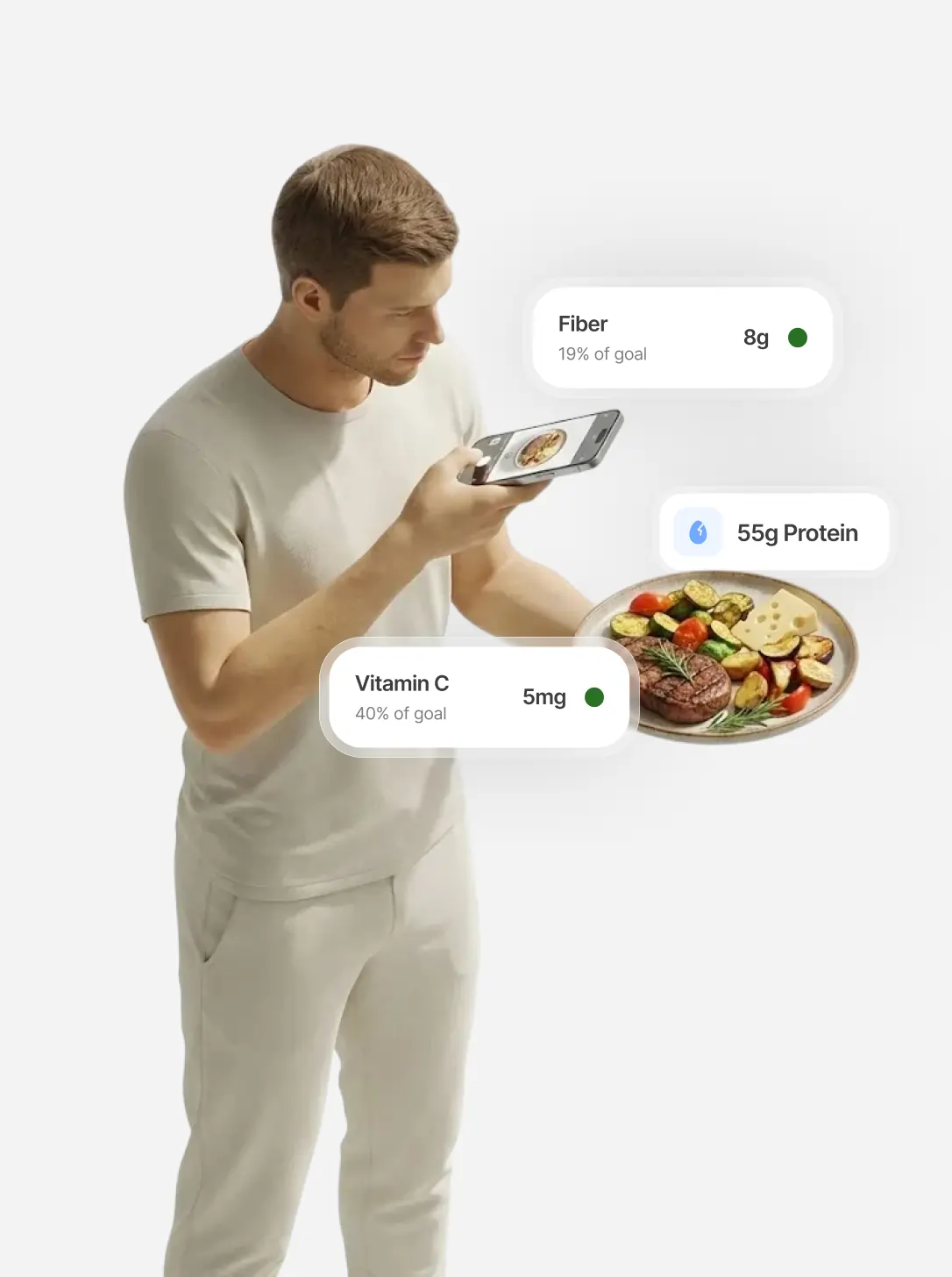
The column that takes the most effort is "last meal", because to judge it properly you need its protein and fiber, which means looking things up. That is where a food tracker helps. IntakeAI is an iPhone and Android nutrition app designed to help you reduce cravings. It estimates calories, macros and 50+ nutrients from a meal photo, barcode, label scan or typed description, and can re-log recent meals. To be clear, it does not have a craving journal: keep your craving notes on paper or in a notes app.
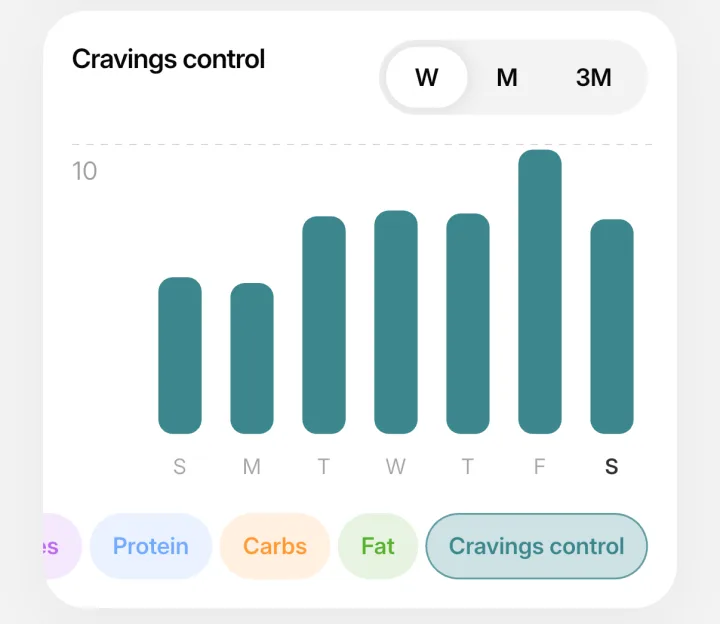
What it does give you is a 0–10 Cravings control score for every logged meal and a daily fullness score, calculated from protein, fiber, calorie density, hyper-palatable combinations, satiety-related nutrients and processing level. Those scores are charted over time, so at day 14 you can put your craving notes next to the chart and check whether your heaviest craving days line up with low-scoring meals. The scores are estimates to guide you; your own notes are what show whether the pattern holds. Photo estimates can misjudge portions or hidden oils, so edit the weight if a result looks wrong. More on lower-effort logging is in our guide to the easiest way to track calories, macros and nutrients.
When a log isn't the right tool
Tracking is not helpful for everyone. If logging makes you anxious, obsessive or guilty, or if you have a history of an eating disorder, stop and talk to a doctor or dietitian first. The same goes if your log reveals frequent episodes of eating large amounts while feeling out of control, which can be a sign of binge eating disorder. For the bigger picture on cravings, start with our main guide: how to reduce food cravings and food noise.
Frequently asked questions
How do I log cravings to find my triggers?
Write a short entry each time a craving hits: time, food wanted, strength 0-10, hunger 0-10, your last meal and how long ago, place and company, mood, last night's sleep, what you did, and the strength 15 minutes later. After 14 days, sort entries by time, hunger, preceding meal and mood to find the patterns.
How long should I track food cravings?
Two weeks is a practical length. It covers weekdays, weekends and some variation in sleep and stress, and leaves room for three days of pure observation, a review at day 7 and one small experiment in the second week.
What are the most common food craving triggers?
Common triggers include long gaps between meals or meals low in protein and fiber, tiredness, stress or boredom, fixed habit times and places such as the sofa at night, and seeing or smelling food. Your log shows which ones apply to you.
Does IntakeAI have a craving journal?
No. IntakeAI logs meals and gives each one a 0-10 Cravings control score plus a daily fullness score, with charts over time. Keep your craving notes on paper or in a notes app and compare them with those charts.
Should I log cravings I resist?
Yes. Resisted cravings show which situations trigger urges and which responses work. Recording the strength 15 minutes later tells you whether waiting, swapping or a planned portion worked best for you.
Related guides

How to Reduce Food Cravings and Food Noise
The main guide: why cravings and constant food thoughts build up, and the meal-level changes that quiet them.
READ MORE
Cravings vs Hunger: How to Tell the Difference
A side-by-side comparison and a quick checklist to work out whether you need food or something else.
READ MORE
How to Control Cravings Without Willpower
Environment design, meal structure, if-then plans and sleep: four levers that reduce how often you need to resist.
READ MOREFill in the “last meal” column automatically
Log meals with a photo, barcode or short description. IntakeAI estimates calories, protein, fiber and 50+ nutrients and charts each meal's Cravings control score over time.
Sources
- Burke LE, Wang J, Sevick MA (2011). Self-monitoring in weight loss: a systematic review of the literature. Journal of the American Dietetic Association, 111(1), 92–102. PubMed
- Richard A, Meule A, Reichenberger J, Blechert J (2017). Food cravings in everyday life: an EMA study on snack-related thoughts, cravings, and consumption. Appetite, 113, 215–223. PubMed
- Hofmann W, Baumeister RF, Förster G, Vohs KD (2012). Everyday temptations: an experience sampling study of desire, conflict, and self-control. Journal of Personality and Social Psychology, 102(6), 1318–1335. PubMed
- Harvey J, Krukowski R, Priest J, West D (2019). Log often, lose more: electronic dietary self-monitoring for weight loss. Obesity, 27(3), 380–384. PubMed
- Smithson EF, Hill AJ (2017). It is not how much you crave but what you do with it that counts: behavioural responses to food craving during weight management. European Journal of Clinical Nutrition, 71(5), 625–630. PubMed
- Pelchat ML (1997). Food cravings in young and elderly adults. Appetite, 28(2), 103–113. PubMed
- Al Khatib HK, Harding SV, Darzi J, Pot GK (2017). The effects of partial sleep deprivation on energy balance: a systematic review and meta-analysis. European Journal of Clinical Nutrition, 71(5), 614–624. PubMed
- NHS. Binge eating disorder. NHS
This article is for general education and is not medical advice. If you have a medical condition, an eating disorder, are pregnant, or take medication, speak to a doctor or registered dietitian before changing your diet. IntakeAI's nutrition figures and scores are estimates to guide your choices.