How to Control Cravings Without Willpower
How do you control cravings without willpower?
You control cravings without willpower by changing the situations that create them: keep trigger foods out of sight and reach, eat regular meals with about 25–30 g of protein, decide your craving response in advance, and sleep at least 7 hours. In one meta-analysis, short sleep alone added about 385 kcal a day. Willpower is what you need when the environment is working against you. The aim of this guide is to set things up so you need it less often — not to make you tougher.
None of this means cravings are a character flaw or that you should never eat the foods you crave. It means the moment of temptation is the worst place to fight the battle. Most of the leverage sits earlier: what is in your cupboard, what you ate at lunch, what you planned to do at 9pm, and how long you slept last night.
Key takeaways
- The idea that willpower is a fuel tank that runs dry is not settled science: a 23-lab replication with 2,141 people found an effect close to zero.
- Distance works: across 12 studies (1,098 people), placing food farther away moderately reduced how much of it people ate.
- A higher-protein diet (25% of calories) lowered late-night desire to eat during a 12-week weight-loss trial in 27 men.
- "If-then" plans help, but more for adding healthy foods than for cutting unhealthy ones (effect sizes of 0.51 vs 0.29 across 23 studies).
- Getting about 1.2 extra hours of sleep cut intake by roughly 270 kcal a day in an 80-person trial.
Is willpower really a limited resource?
For years, popular advice was built on "ego depletion": the idea that self-control is a finite resource that drains as you use it, so by evening you have nothing left to resist the biscuit tin. The theory is intuitive, and you will still see it presented as fact.
The evidence is much shakier than that. In a preregistered replication across 23 laboratories with 2,141 participants, the ego-depletion effect was d = 0.04 — small, with a confidence interval that included zero. Critics argue the task used may not have been depleting enough, so the honest summary is that the evidence is mixed, not that willpower is fake.
What is clearer is that situations matter. In a week-long experience-sampling study of 205 adults who reported 7,827 desire episodes, desires were frequent and mostly unproblematic, and situational factors — such as being with other people who were already eating or drinking — had relatively more influence on whether people resisted or gave in. That is a useful reframe: instead of asking "how do I resist harder?", ask "which situations keep putting me in this position?"
The four levers that do the work for you
The table below compares the willpower approach with a system-based alternative, along with the strongest evidence we could verify for each lever.
| Lever | Willpower approach | System approach | What the research found |
|---|---|---|---|
| Environment | Keep snacks at home and "just don't eat them" | Store them out of sight, out of reach, or not at all | Food placed farther away reduced consumption (SMD −0.60; 12 studies, 1,098 people; low-certainty evidence) |
| Meal structure | Skip meals, then resist evening hunger | Regular meals built around protein and fiber | 25% vs 14% protein: late-night desire to eat 13 vs 27 mm on a 100 mm scale (27 men, 12 weeks) |
| Pre-decided responses | Decide in the moment | Write "if X happens, I will do Y" plans | d = 0.51 for eating more healthy foods, d = 0.29 for eating less unhealthy food (23 studies) |
| Sleep | Push through tired evenings | Protect a 7–9 hour sleep window | Partial sleep loss: +385 kcal/day (11 studies, 172 people, ≤2 weeks). Sleep extension: −270 kcal/day (80 adults) |
1. Design your environment so the easy choice is the good one
A 2019 Cochrane review of 24 studies found that putting food farther away reduced how much people ate, and that the effect grew with distance. Offering fewer less-healthy options also reduced how often they were chosen. The certainty is rated low — most studies were short and lab-based — but the direction is consistent and the cost of trying it is zero.
Practical versions that work at home:
- Move, don't ban. Put trigger foods in an opaque tub on a high shelf or in the garage. Put fruit, yogurt or pre-cooked chicken at eye level in the fridge.
- Buy single portions. A share bag invites "just one more handful". A single bar has a built-in stopping point.
- Break the route. If you always pass the vending machine or bakery at 3pm, change the route or the time.
- Close the kitchen. Brushing your teeth or turning off the kitchen light after dinner is a small, visible cue that eating is done for the day.
2. Let meal structure prevent the craving from forming
Many evening cravings are partly unmet hunger wearing a disguise. In a 12-week weight-loss trial of 27 men with overweight or obesity, those eating 25% of calories from protein reported more fullness through the day and lower late-night desire to eat and preoccupation with food than those eating 14% protein. Daily hunger ratings did not differ, and eating six times a day instead of three gave no benefit — so there is no need to graze.
A simple structure: three meals (plus one planned snack if your schedule is long), each with a palm-sized protein portion and a vegetable, fruit, beans or whole grain for fiber. If you are unsure what that looks like in practice, our guide to foods that reduce cravings and keep you full covers specific options.
3. Pre-decide your response with implementation intentions
An implementation intention is a specific "if-then" plan: "If I want something sweet after dinner, then I will have a yogurt with berries and leave the kitchen." A meta-analysis of 23 studies found these plans helped people eat more healthy foods (d = 0.51) and, less strongly, eat fewer unhealthy ones (d = 0.29). That second number is modest, so treat if-then plans as one tool, not the whole fix.
They work best when the "if" is a concrete cue you can recognize (a time, a place, a feeling) and the "then" is something you can actually do in that place. "If I'm stressed, I'll meditate for 20 minutes" fails at the office. "If I'm stressed at my desk, I'll refill my water bottle and walk to the far kitchen" is doable.
4. Treat sleep as a craving intervention
A meta-analysis of sleep-restriction studies found that partial sleep deprivation increased energy intake by about 385 kcal a day with no matching rise in energy burned. The studies were short (2 weeks at most), so this is not proof of long-term weight change. Brain imaging work suggests one reason: after a night without sleep, people in a Berkeley study showed lower activity in frontal regions that evaluate food and a stronger desire for high-calorie foods.
The encouraging side comes from a randomized trial in 80 adults with overweight who habitually slept under 6.5 hours. A single sleep-hygiene counseling session extended sleep by about 1.2 hours a night, and that group ate roughly 270 kcal a day less than controls, measured objectively in their normal lives. The CDC recommends 7 or more hours for adults aged 18–60.
Track calories & nutrients fast


A 7-day setup plan
Changing everything at once is its own willpower test. Add one lever at a time:
- Day 1 – Audit. Walk through your kitchen, desk and car. Note every food you tend to eat without planning to. Move or remove the top three.
- Day 2 – Restock. Put two ready-to-eat, higher-protein options where the trigger foods used to be (Greek yogurt, boiled eggs, cottage cheese, edamame).
- Day 3 – Fix the weakest meal. Find the meal you most often skip or make tiny, usually breakfast or lunch, and add a protein portion to it.
- Day 4 – Write three if-then plans. One for your most common craving time, one for stress, one for social situations.
- Day 5 – Set a sleep window. Choose a fixed wake time and count back 8 hours. Set a reminder 30 minutes before that bedtime.
- Day 6 – Plan the treat. Decide when you will have the food you crave most, in a set portion, so it is a choice rather than a lapse.
- Day 7 – Review. Which craving still showed up? Match it to a lever you have not pulled yet.
If you find it hard to tell whether what you feel at 9pm is a craving or genuine hunger, read how to tell cravings and hunger apart first — the fix is different for each.
Checking your meal structure: notebook vs app
The meal-structure lever only works if you know whether your meals actually contain enough protein and fiber. You can check this by hand: for three days, write down each meal, look up protein and fiber on the packaging or in the USDA FoodData Central database, and mark any meal under about 25 g protein. Then look at what you ate before your strongest cravings. It is tedious, but three days is usually enough to spot a pattern, such as a 12 g-protein lunch followed by a 4pm vending-machine run.
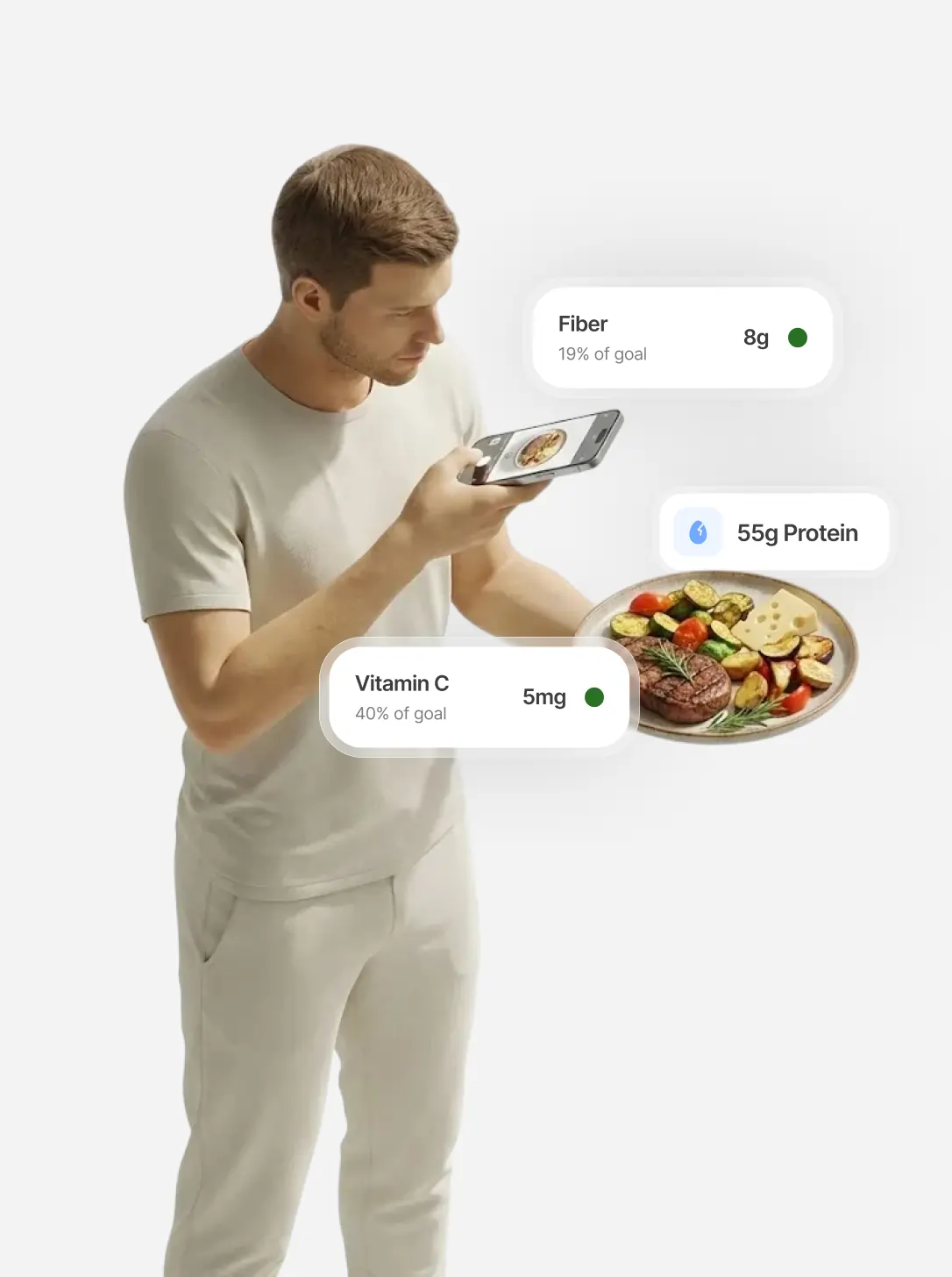
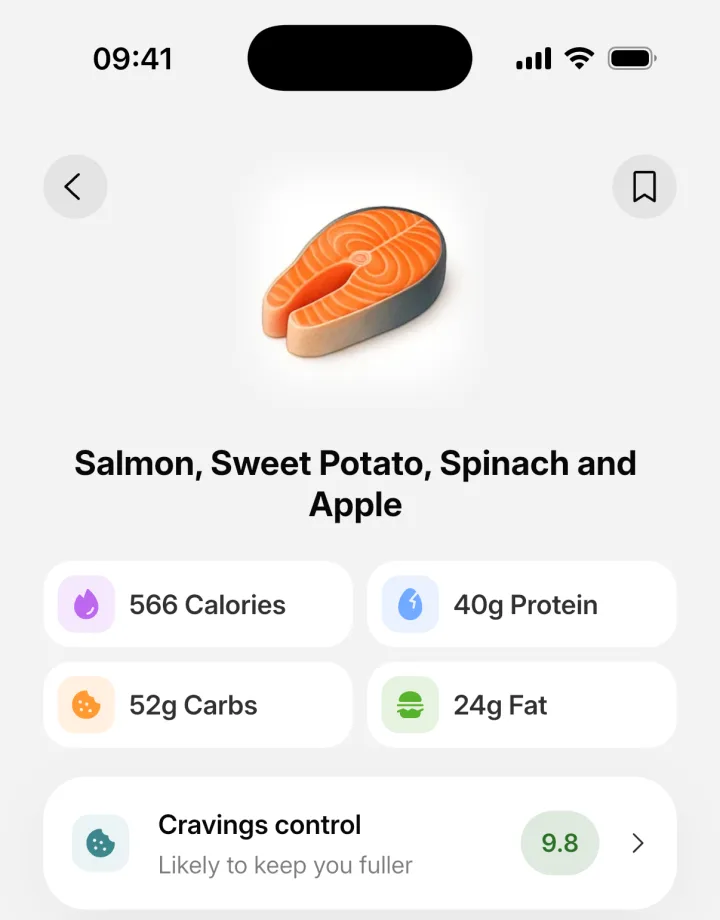
If you would rather not do the lookups, IntakeAI does that part for you. IntakeAI is an iPhone and Android nutrition app designed to help you reduce cravings. It estimates calories, protein, fiber and 50+ nutrients from a meal photo, barcode, nutrition label or typed description. Alongside the numbers, each meal gets a 0–10 Cravings control score calculated from a transparent formula: protein, fiber, calorie density, hyper-palatable combinations, satiety-related nutrients and processing level. It is a guide to how filling a meal is likely to be, not a guarantee that a craving won't show up.
Photo estimates can be wrong on portion size or hidden cooking oil, so check the result and edit the weight if it looks off. The useful part for this guide is the daily protein bar: if it is still near empty at 3pm, you have found your craving window before it arrives.
When cravings are not a habits problem
If you regularly eat large amounts in a short time while feeling out of control, and feel distressed afterwards, that may be binge eating disorder rather than ordinary cravings. Environment tweaks can help, but it is worth speaking to a GP, doctor or registered dietitian. The same applies if you take appetite-affecting medication such as a GLP-1 drug, or if you notice food thoughts changing sharply alongside low mood or poor sleep.
For the wider picture of why cravings build up in the first place, see our main guide on how to reduce food cravings and food noise, and for the full evidence summary, science-backed ways to reduce food cravings. If your main goal is fat loss, our guide to losing weight without feeling hungry applies the same levers to a calorie deficit.
Frequently asked questions
Can you stop cravings without willpower?
You can make cravings less frequent and weaker without relying on willpower, but you cannot switch them off entirely. Most of the effect comes from moving trigger foods out of sight and reach, eating regular protein- and fiber-rich meals, planning if-then responses in advance and sleeping at least 7 hours.
Is willpower a finite resource?
The evidence is mixed. The popular ego-depletion theory says self-control runs out with use, but a 23-lab replication with 2,141 participants found an effect close to zero (d = 0.04). Situations and habits appear to explain more of everyday eating than a draining willpower tank.
What are weight loss tips that don't rely on willpower?
Keep tempting foods out of sight, buy single portions, build each meal around a palm-sized protein portion plus fiber, write if-then plans for your usual craving times, protect a 7-9 hour sleep window, and plan small treats in advance so they are a choice rather than a lapse.
Why are cravings worse at night?
Evening cravings are often a mix of habit, tiredness and under-eating earlier in the day. In a 12-week trial, men eating 25% of calories from protein reported lower late-night desire to eat than those eating 14% protein, and short sleep has been linked to higher next-day intake.
Does IntakeAI stop cravings?
No app can stop cravings. IntakeAI estimates the nutrition of each meal and gives it a 0-10 Cravings control score based on protein, fiber, calorie density, processing and other factors, so you can see which meals are likely to be more filling. Treat it as a guide, not a guarantee.
Related guides
How to Reduce Food Cravings and Food Noise
The main guide: why cravings and constant food thoughts build up, and the meal-level changes that quiet them.
READ MORE
Cravings vs Hunger: How to Tell the Difference
A side-by-side comparison and a quick checklist to work out whether you need food or something else.
READ MORE
Best Way to Track Food Cravings and Learn Your Triggers
A simple craving log template and a two-week method for finding the patterns behind your cravings.
READ MORESee which of your meals keep cravings quieter
Log a meal with a photo, barcode or short description and IntakeAI estimates its calories, protein, fiber and 50+ nutrients, plus a 0–10 Cravings control score you can track over time.
Sources
- Hagger MS, Chatzisarantis NLD, et al. (2016). A multilab preregistered replication of the ego-depletion effect. Perspectives on Psychological Science, 11(4), 546–573. PubMed
- Hofmann W, Baumeister RF, Förster G, Vohs KD (2012). Everyday temptations: an experience sampling study of desire, conflict, and self-control. Journal of Personality and Social Psychology, 102(6), 1318–1335. PubMed
- Hollands GJ, et al. (2019). Altering the availability or proximity of food, alcohol, and tobacco products to change their selection and consumption. Cochrane Database of Systematic Reviews, CD012573. PubMed
- Leidy HJ, Tang M, Armstrong CL, Martin CB, Campbell WW (2011). The effects of consuming frequent, higher protein meals on appetite and satiety during weight loss in overweight/obese men. Obesity, 19(4), 818–824. PubMed
- Adriaanse MA, Vinkers CDW, De Ridder DTD, Hox JJ, De Wit JBF (2011). Do implementation intentions help to eat a healthy diet? A systematic review and meta-analysis of the empirical evidence. Appetite, 56(1), 183–193. PubMed
- Al Khatib HK, Harding SV, Darzi J, Pot GK (2017). The effects of partial sleep deprivation on energy balance: a systematic review and meta-analysis. European Journal of Clinical Nutrition, 71(5), 614–624. PubMed
- Greer SM, Goldstein AN, Walker MP (2013). The impact of sleep deprivation on food desire in the human brain. Nature Communications, 4, 2259. PubMed
- Tasali E, Wroblewski K, Kahn E, Kilkus J, Schoeller DA (2022). Effect of sleep extension on objectively assessed energy intake among adults with overweight in real-life settings: a randomized clinical trial. JAMA Internal Medicine, 182(4), 365–374. PubMed
- Centers for Disease Control and Prevention. About sleep. CDC
This article is for general education and is not medical advice. If you have a medical condition, an eating disorder, are pregnant, or take medication, speak to a doctor or registered dietitian before changing your diet. IntakeAI's nutrition figures and scores are estimates to guide your choices.