How to Build a Weight Loss Meal That Controls Cravings
How do you build a weight loss meal that controls cravings?
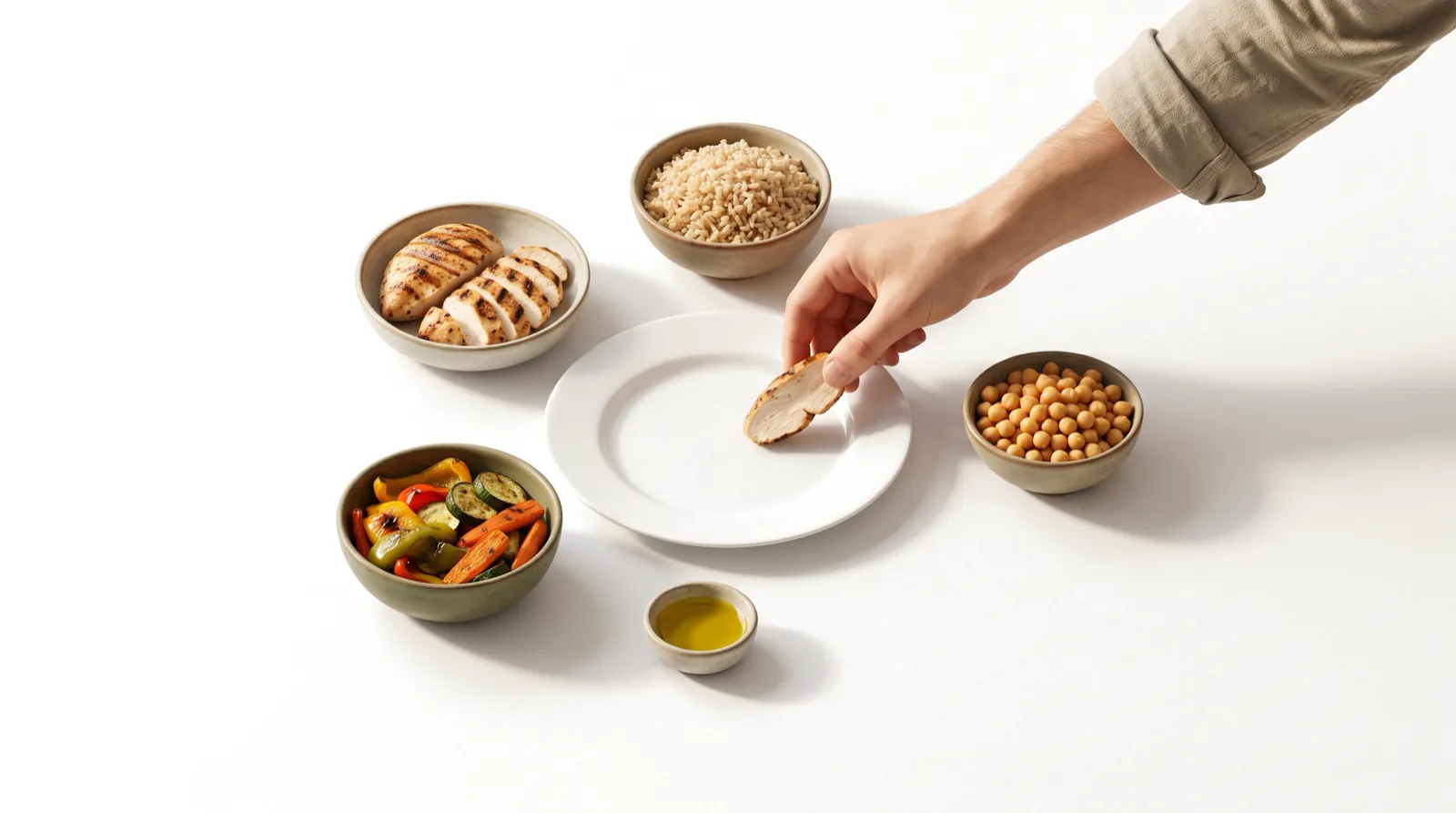
Build each meal from four parts: 25–40 g of protein, half a plate of vegetables or fruit for 8–10 g or more of fiber, a quarter-plate of minimally processed carbohydrate, and about 10–15 g of added fat, which typically totals 450–600 calories. That combination targets the things that most consistently predict fullness per calorie: protein, fiber, food volume and low processing. Calories decide weight change; composition decides how hard the deficit feels.
Below you will find each part of the formula with numbers, a worked makeover of a typical 600 kcal lunch, and a detailed look at the six factors that IntakeAI uses to score a meal's "Cravings control."
Key takeaways
- Protein is the anchor: raising protein from 15% to 30% of calories cut spontaneous intake by about 441 kcal a day in a 19-person trial.
- Half the plate should be water-rich vegetables or fruit, which lowers calorie density and adds fiber.
- The same 600 calories can be a 210 g sandwich with about 3 g of fiber or a 600 g plate with about 16 g of fiber and twice the protein.
- Hyper-palatable combinations of fat with sugar or salt are common: 62% of foods in a US food database met one research definition.
- IntakeAI's Cravings control score is a weighted average of six factors, with protein weighted highest; it is a guide, not a guarantee.
What does each part of the plate do?
| Plate part | Target per meal | Visual guide | Examples |
|---|---|---|---|
| Protein | 25–40 g protein (~150–250 kcal) | 1–1.5 palms | 120–150 g cooked chicken or fish, 250 g nonfat Greek yogurt, 200 g firm tofu, 3 eggs plus egg whites |
| Vegetables / fruit | 200–300 g, 8–10 g+ fiber with the carb (~50–100 kcal) | Half the plate | Broccoli, salad, peppers, green beans, berries, apples |
| Smart carbohydrate | 30–45 g carbs (~150–200 kcal) | A quarter-plate or 1 cupped hand | Boiled potatoes, oats, lentils, beans, brown rice, whole-grain bread |
| Fat | 10–15 g added fat (~90–135 kcal) | 1 thumb | 1 tbsp olive oil, 50 g avocado, 15 g nuts, 30 g feta |
Protein: the strongest lever
In a 2005 trial of 19 adults, raising protein from 15% to 30% of calories (while keeping carbohydrate constant) reduced how much people chose to eat by about 441 kcal per day, and they lost weight over the following 12 weeks without being told to restrict. A 12-week trial in 27 men with overweight or obesity adds nuance: during a 750 kcal/day deficit, the higher-protein group (25% of energy) reported more fullness across the day and lower late-night desire to eat and preoccupation with food than the normal-protein group (14%), but overall daily hunger did not differ. Protein helps; it is not an off-switch. Spreading 25–40 g across each main meal is a practical way to reach a higher total.
Vegetables and fiber: volume and bulk
US Dietary Reference Intakes set fiber at 14 g per 1,000 kcal, about 25 g a day for women and 38 g for men, according to the American Dietetic Association position paper. A weight loss meal of around 500 kcal therefore needs 7 g or more to stay on pace. Be realistic about what fiber does on its own: a systematic review of 44 studies found that only 39% of single-meal fiber treatments reduced appetite and 22% reduced food intake. The benefit seems to come mainly from whole, bulky high-fiber foods that also lower calorie density, which is why the formula asks for a half-plate of vegetables, not a fiber supplement.
Smart carbohydrate: keep it, choose it
Cutting carbohydrate entirely often leaves meals unsatisfying. Choose minimally processed sources that are bulky for their calories. Boiled potatoes produced the highest score of 38 foods in the 1995 satiety index study, and lentils, beans and oats bring fiber with them.
Fat: measured, not removed
Fat makes food taste good and helps absorb vitamins A, D, E and K, but at about 9 kcal per gram it is the easiest place to overshoot. A free-poured "drizzle" of oil can be 2–3 tablespoons, or 240–360 kcal. Measure it for a week and you will learn what one tablespoon looks like.
Putting the plate together
- Choose the protein first and portion 25–40 g of it.
- Fill half the plate with vegetables or fruit, at least 200 g.
- Add a quarter-plate of potatoes, legumes, oats or whole grains.
- Add one measured fat: oil, avocado, nuts, cheese or a dressing.
- Season generously with herbs, spices, citrus, vinegar or hot sauce, which add flavor for almost no calories.
- Check the total: 450–600 kcal suits most adults eating three meals in a moderate deficit.
Before and after: upgrading a 600 calorie sandwich
Here is a common café-style lunch rebuilt with the formula. Figures are approximate, based on typical food database values, and will vary by brand.
| Measure | Before: ham and cheese baguette | After: chicken sandwich plate |
|---|---|---|
| What's on the plate | 120 g white baguette, 10 g butter, 10 g mayonnaise, 40 g ham, 30 g cheddar | 2 slices whole-grain bread, 120 g roast chicken breast, 30 g hummus, 100 g lettuce, tomato and cucumber, 100 g carrot sticks, 1 apple |
| Calories | ~605 kcal | ~605 kcal |
| Protein | ~24 g | ~50 g |
| Fiber | ~3 g | ~16 g |
| Food weight | ~210 g | ~610 g |
| Calorie density | ~2.9 kcal/g (medium band) | ~1.0 kcal/g (low band) |
| Processing | Mostly processed and ultra-processed (white bread, ham) | Mostly whole or minimally processed foods |
| Fat + salt combination | Yes (butter, mayo, ham, cheese) | Much lower |
Same calories, roughly double the protein, five times the fiber and three times the food. If you want a lower-calorie version, drop the apple and you are at about 510 kcal with 14 g of fiber. The "after" plate is not exotic; it uses supermarket staples and takes five minutes. For more plates built this way, see our high-protein, high-fiber meals for fat loss.
Track calories & nutrients fast


What are the six factors that predict whether a meal controls cravings?
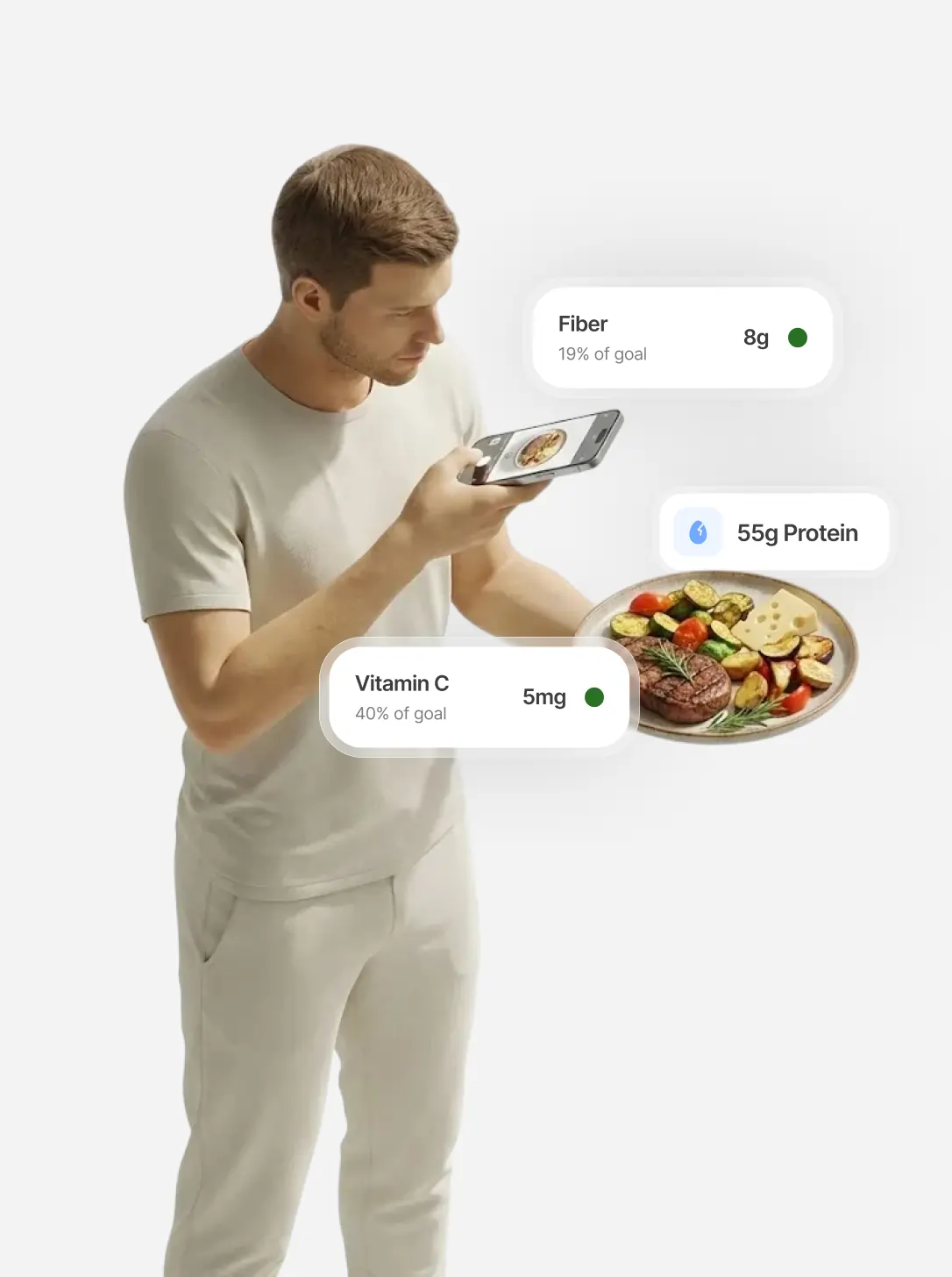
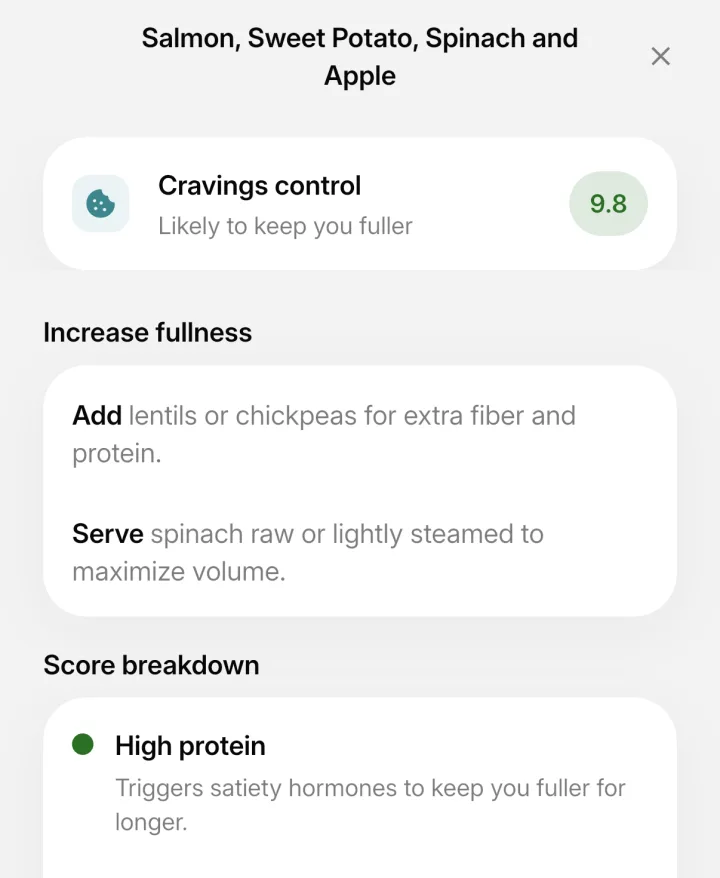
IntakeAI condenses the same ideas into a per-meal Cravings control score from 0 to 10. It is a transparent formula rather than an AI guess: a weighted average of six factors, with the weights below adding up to 11. Understanding them is useful even if you never use the app, because each one is something you can check yourself.
| Factor | Weight | Share of score | What scores well |
|---|---|---|---|
| Protein | 3 | ~27% | 25 g or more per meal scores full marks |
| Fiber | 2 | ~18% | 10 g or more scores full marks |
| Calorie density | 2 | ~18% | Under 0.6 kcal/g best; over 4 kcal/g worst |
| Hyper-palatability | 1.5 | ~14% | Avoiding fat + sugar or fat/carb + salt combinations |
| Satiety nutrients | 1.5 | ~14% | Potassium, magnesium, calcium, zinc, iron and B12 |
| Processing level | 1 | ~9% | NOVA group 1 (unprocessed or minimally processed) |
1. Protein (weight 3)
Weighted highest because it has the most consistent evidence, as covered above. A meal reaching 25 g gets full marks on this factor.
2. Fiber (weight 2)
Full marks at 10 g per meal, which is roughly what you need across three meals to approach the daily recommendation.
3. Calorie density (weight 2)
Meals under 0.6 kcal/g score best and meals over 4 kcal/g score worst. The thresholds mirror the energy density research: in a lab study of 42 women, a large low-density salad before lunch reduced total intake, while a dense version of the same salad increased it. Our guide to low calorie high volume meals goes deeper.
4. Hyper-palatability (weight 1.5)
The score flags combinations that make food easy to overeat: fat with sugar, or fat or refined carbohydrate with salt. Researchers have proposed similar numeric definitions; one 2019 analysis found that 62% of 7,757 foods in a US food database met at least one hyper-palatable cluster, including some labelled reduced-fat.
5. Satiety nutrients (weight 1.5)
This factor rewards meals that supply potassium, magnesium, calcium, zinc, iron and vitamin B12. These tend to come with whole foods like vegetables, legumes, dairy, fish and meat, so it works partly as a marker of a nutrient-dense, minimally processed meal. Direct evidence that these specific minerals reduce cravings on their own is limited, which is one reason the factor carries less weight than protein.
6. Processing level (weight 1)
Foods are graded by NOVA group 1–4, the system researchers use to classify foods by the extent of industrial processing (Monteiro et al., 2019). In a tightly controlled NIH inpatient trial of 20 adults, people ate about 500 kcal a day more on an ultra-processed diet than on an unprocessed one when both were offered freely. It was a small, four-week study, but it is the clearest causal evidence so far.
The score is labelled below 4 as "Likely to trigger cravings," 4–7 as "Moderate fullness," and 7 or above as "Likely to keep you fuller." The "before" sandwich above would lose points for protein, fiber, density, processing and its fat-plus-salt profile; the "after" plate would score full marks on protein and fiber and land in a much better density range. If you want the bigger picture on why cravings happen, see our hub on reducing food cravings and food noise.
How to score your meals manually or with an app
Manually: for each meal, write down protein and fiber grams from labels or a food database, weigh the plate to get calories per gram, and ask three questions: is fat combined with sugar or salt, are most ingredients whole foods, and does the plate include vegetables, legumes, dairy, fish or meat? A week of this shows you which of your regular meals are working.
With IntakeAI: IntakeAI is an iPhone and Android app that estimates calories, macros and over 50 nutrients from a meal photo, barcode, nutrition label or typed description, then calculates the Cravings control score for that meal automatically. Each meal also gets two AI-written "Increase fullness" tips, and your meals roll up into a daily fullness score you can follow on a chart over time. The score is hidden if your goal is weight gain, since it is designed for eating in a deficit.
Like any photo-based estimate, the AI can misjudge portion sizes or miss cooking oil, so check the result and edit portions when something looks off. The score is only as good as the meal data behind it, and it is an estimate to guide choices, not proof that a meal will prevent cravings.
Frequently asked questions
What should a weight loss meal contain to control cravings?
A practical formula is 25 to 40 g of protein, at least half the plate from vegetables or fruit for 8 to 10 g of fiber or more, a quarter-plate of minimally processed carbohydrate such as potatoes, oats, legumes or whole grains, and about 10 to 15 g of added fat. That usually lands between 450 and 600 calories.
How much protein per meal helps with cravings?
Around 25 to 40 g per meal is a common, evidence-informed target. In a 12-week trial of 27 men in a calorie deficit, a diet with 25% of energy from protein produced more daily fullness and lower late-night desire to eat than one with 14%, although overall daily hunger did not differ.
Is fiber or protein more important for fullness?
Both help, but protein has the more consistent evidence for reducing intake. Many single-meal fiber trials show no effect, so fiber works best as part of whole, bulky foods like vegetables, legumes and whole grains rather than as a supplement. A good meal uses both.
How does IntakeAI's Cravings control score work?
It is a transparent formula, not an AI guess. Each meal gets a 0 to 10 score from a weighted average of six factors: protein (weight 3), fiber (2), calorie density (2), hyper-palatability (1.5), satiety nutrients (1.5) and processing level (1). Below 4 is labelled likely to trigger cravings, 4 to 7 moderate fullness, and 7 or above likely to keep you fuller. It is an estimate to guide choices.
Can a well-built meal stop cravings completely?
No meal can guarantee that. Sleep, stress, habits and the food around you also drive cravings. Better-built meals tend to make hunger and cravings easier to manage. If you experience frequent loss-of-control eating, speak to a doctor or registered dietitian, as this can be a sign of binge eating disorder.
Related guides
How to Lose Weight Without Feeling Hungry All the Time
The hub guide to keeping a calorie deficit without constant hunger, and why meal composition matters.
READ MORE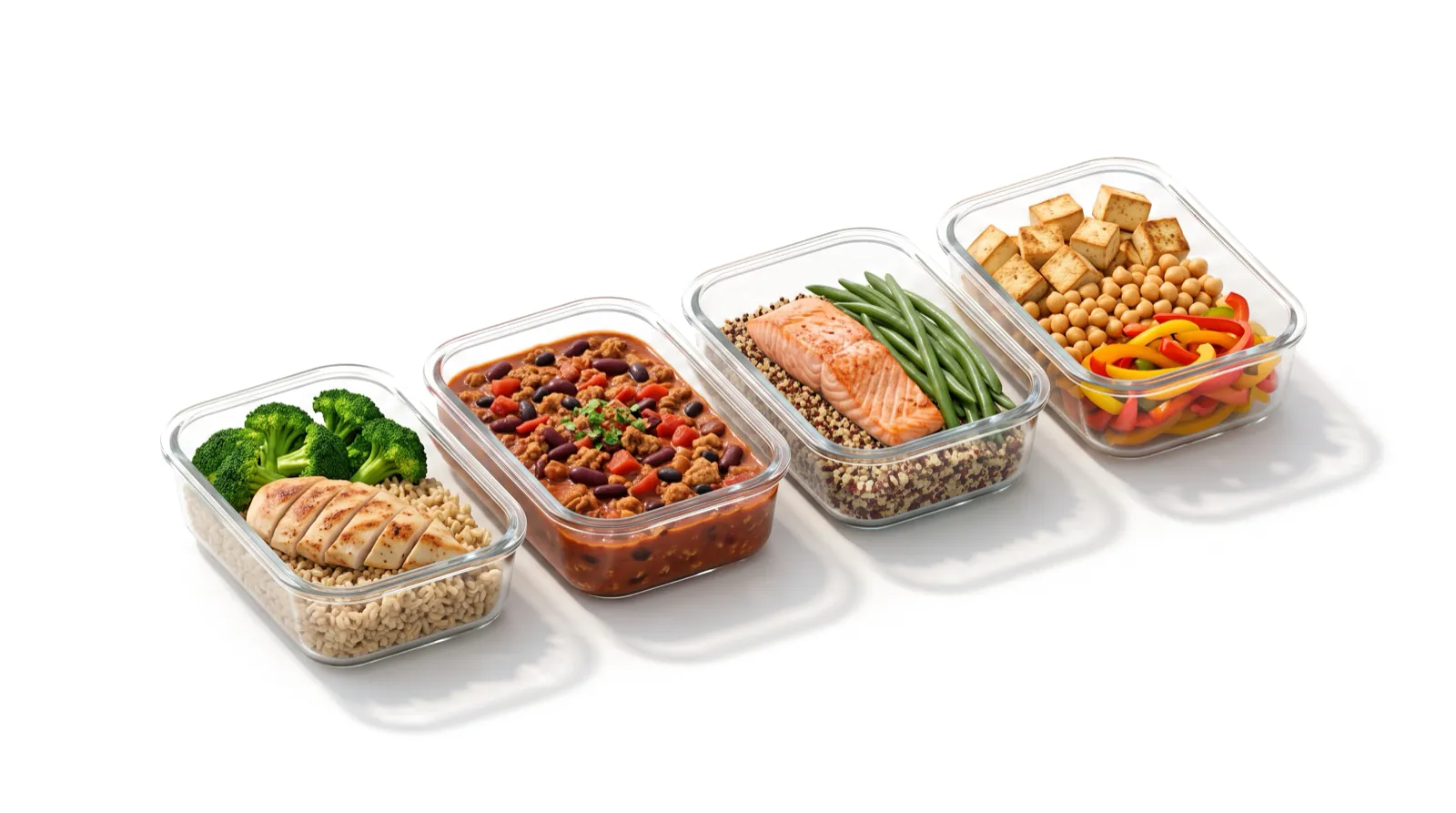
High Protein and High Fiber Meals for Fat Loss
Recipe-level meals that hit both protein and fiber targets in one plate.
READ MORE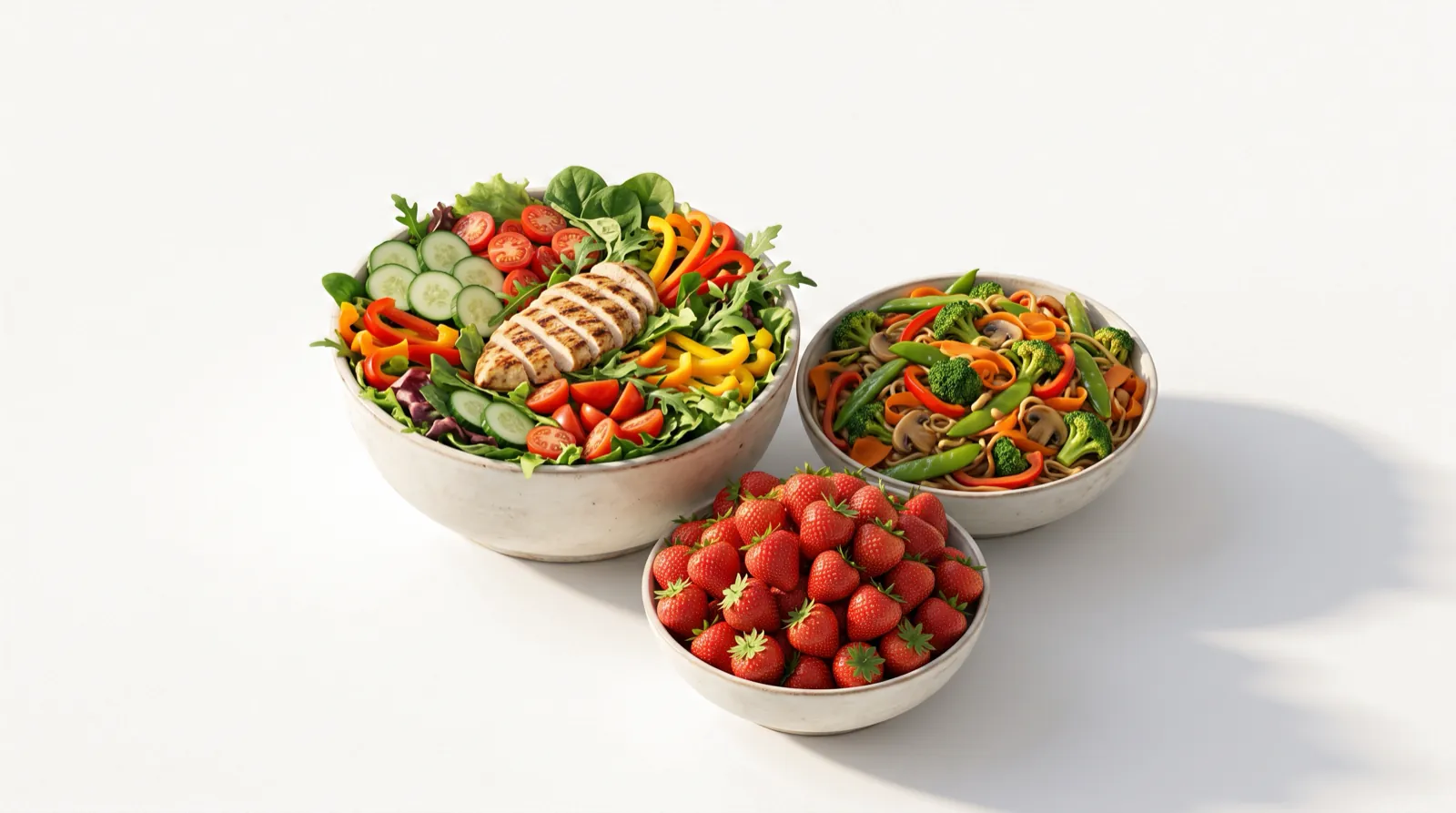
Low Calorie High Volume Meals That Keep You Satisfied
The energy density research and ten big-plate meals under about 500 calories.
READ MOREBuild meals that keep you fuller, one log at a time
IntakeAI estimates calories, protein, fiber and 50+ nutrients from a photo, barcode or text description, then gives each meal a 0–10 Cravings control score with two tips to increase fullness. Available on iPhone and Android.
Sources
- Weigle DS, Breen PA, Matthys CC, et al. (2005). A high-protein diet induces sustained reductions in appetite, ad libitum caloric intake, and body weight despite compensatory changes in diurnal plasma leptin and ghrelin concentrations. American Journal of Clinical Nutrition, 82(1), 41–48. PubMed
- Leidy HJ, Tang M, Armstrong CL, Martin CB, Campbell WW (2011). The effects of consuming frequent, higher protein meals on appetite and satiety during weight loss in overweight/obese men. Obesity, 19(4), 818–824. PubMed
- Slavin JL (2008). Position of the American Dietetic Association: health implications of dietary fiber. Journal of the American Dietetic Association, 108(10), 1716–1731. PubMed
- Clark MJ, Slavin JL (2013). The effect of fiber on satiety and food intake: a systematic review. Journal of the American College of Nutrition, 32(3), 200–211. PubMed
- Rolls BJ, Roe LS, Meengs JS (2004). Salad and satiety: energy density and portion size of a first-course salad affect energy intake at lunch. Journal of the American Dietetic Association, 104(10), 1570–1576. PubMed
- Fazzino TL, Rohde K, Sullivan DK (2019). Hyper-palatable foods: development of a quantitative definition and application to the US food system database. Obesity, 27(11), 1761–1768. PubMed
- Hall KD, Ayuketah A, Brychta R, et al. (2019). Ultra-processed diets cause excess calorie intake and weight gain: an inpatient randomized controlled trial of ad libitum food intake. Cell Metabolism, 30(1), 67–77. PubMed
- Monteiro CA, Cannon G, Levy RB, et al. (2019). Ultra-processed foods: what they are and how to identify them. Public Health Nutrition, 22(5), 936–941. PubMed
- Holt SH, Miller JC, Petocz P, Farmakalidis E (1995). A satiety index of common foods. European Journal of Clinical Nutrition, 49(9), 675–690. PubMed
This article is for general education and is not medical advice. If you have a medical condition, an eating disorder, are pregnant, or take medication, speak to a doctor or registered dietitian before changing your diet. IntakeAI's nutrition figures and scores are estimates to guide your choices.