The cravings app that shows which meals will keep you full
IntakeAI is designed to help you reduce cravings. Snap a photo of your meal and it scores how filling the meal is from 0 to 10, shows what is driving the score, and gives you two ways to make it more filling. Calories, macros and 50+ nutrients come with it.


iPhone and Android. Paid subscription, free trial on the annual plan.
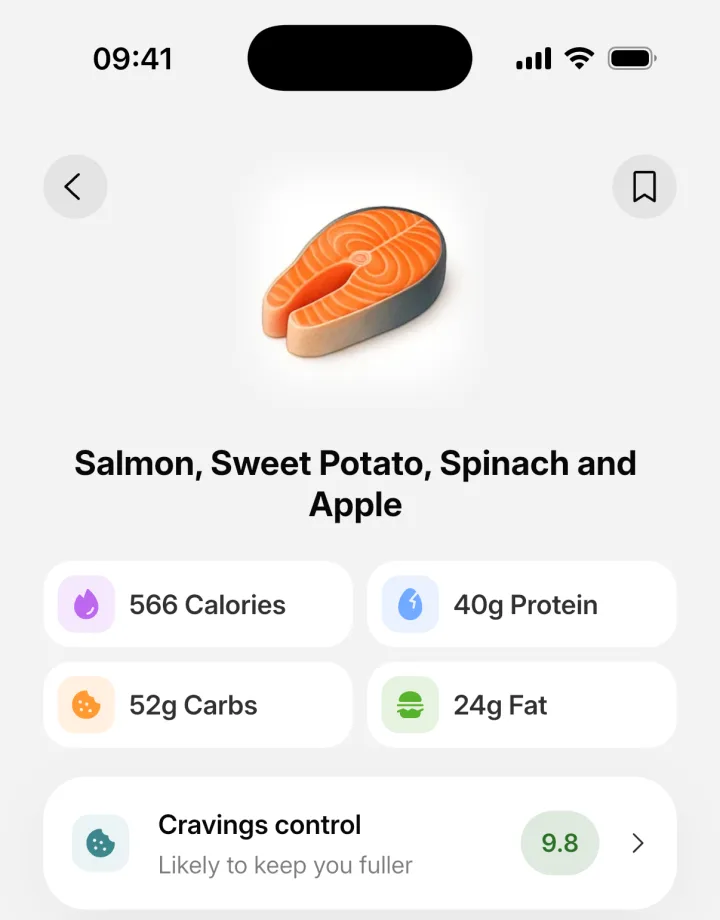
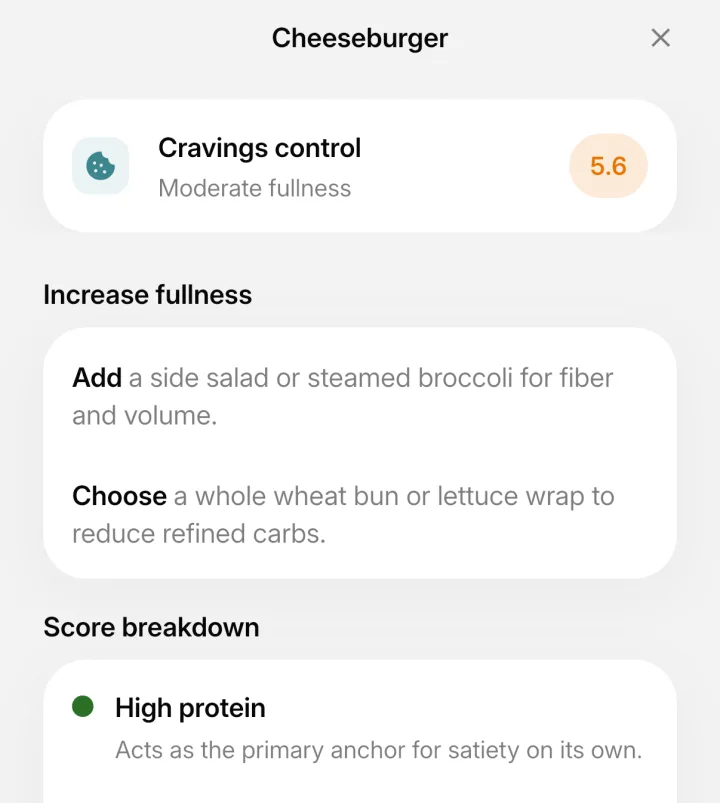
See how filling a meal is, not just its calories
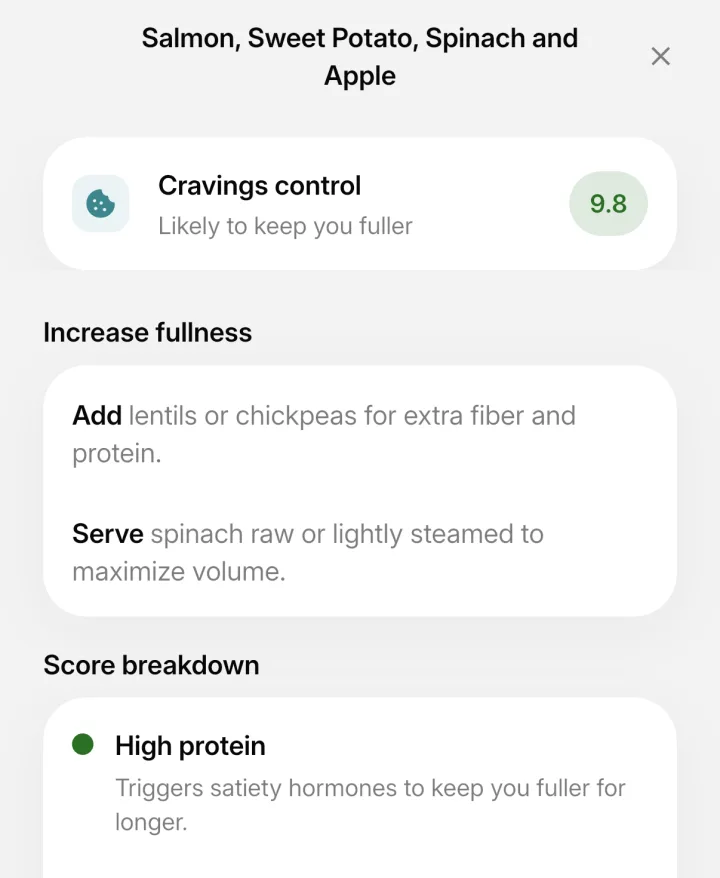
Two tips to make each meal more filling
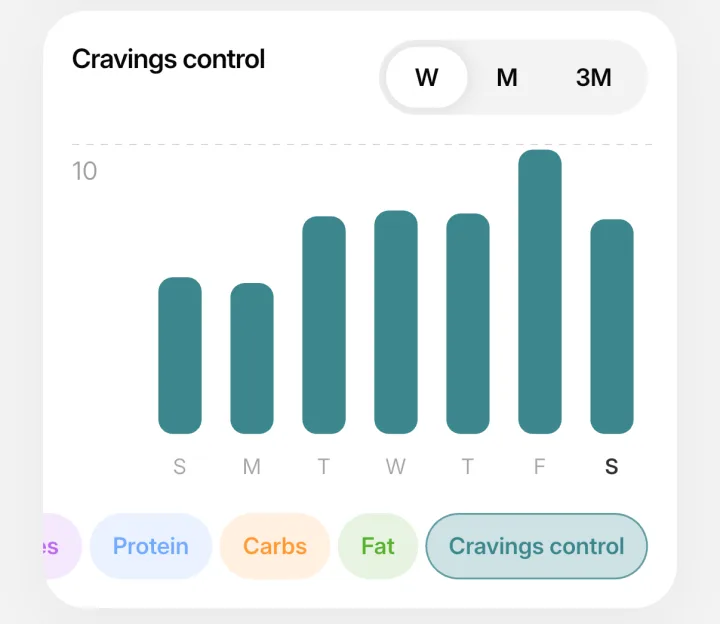
Spot the days that set up a craving
How the Cravings control score is calculated
The score is a fixed formula, not an AI guess. AI estimates the nutrients in your meal; the formula below turns them into a score. Here it is in full.
| Factor | Weight | Full marks (10/10) | Zero |
|---|---|---|---|
| Protein | 3 | 25 g or more, with protein supplying at least 15% of the meal's calories | No protein (scales evenly in between) |
| Fiber | 2 | 10 g or more | No fiber (scales evenly in between) |
| Calorie density | 2 | Under 0.6 kcal per gram of food (drinks are left out) | Over 4 kcal per gram |
| Hyper-palatable foods | 1.5 | Under 20% of the meal's calories come from them | 40% or more (20–40% scores 5) |
| Satiety nutrients | 1.5 | 3 or more of potassium, magnesium, calcium, zinc, iron and B12 | None (1 scores 4, 2 score 7) |
| Processing | 1 | Mostly unprocessed foods | Mostly ultra-processed (processed culinary ingredients score 7, processed foods 5) |
The score is the weighted average of the six factors, rounded to one decimal. A factor the app can't estimate for a meal is left out rather than guessed, and if too much is missing the score shows N/A. Some details:
- Protein scores on whichever is lower: the amount (out of 25 g) or protein's share of the meal's calories (out of 15%). A big portion of a low-protein food, like a large bowl of cereal, can't reach full marks on size alone.
- Calorie density leaves drinks out, as energy-density research does, so a glass of water or juice doesn't make a meal look lighter. Milk poured on cereal counts as food.
- Hyper-palatable follows a 2019 research definition: a food counts if fat and sugar each supply more than 20% of its calories, fat supplies more than 25% with sodium at 0.30% or more of its weight, or carbs supply more than 40% with sodium at 0.20% or more. Whole and minimally processed foods are never flagged, because the app can't tell the sugar in fruit from added sugar.
- Satiety nutrients count when the meal gives you at least as large a share of your daily target as it does of your daily calories. A meal that is 30% of your calories needs at least 30% of your potassium target for potassium to count.
- Processing uses the NOVA groups, averaged across the meal by calories. It is left out if foods with a known processing level cover less than half the meal's calories.
Why these six factors
- Protein gets the most weight because it has the strongest evidence for fullness. In a small trial of 19 adults, raising protein from 15% to 30% of calories led people to eat about 441 kcal a day less without being told to.
- Calorie density matters because people tend to eat a similar weight of food. In a year-long trial of 97 women, those told to cut fat and eat more water-rich fruit and vegetables ate a greater weight of food, reported less hunger and lost more weight than a group that only cut fat.
- Fiber adds bulk and slows a meal down, though the evidence is mixed: a review of 107 fiber treatments found most did not cut appetite in the short term. That is why it weighs less than protein.
- Hyper-palatable and ultra-processed foods are easy to overeat. The hyper-palatable thresholds come from a 2019 definition that classed 62% of foods in a US database as hyper-palatable, and in a 2-week NIH inpatient trial of 20 adults, people ate about 500 kcal a day more on an ultra-processed diet than on an unprocessed one.
- Satiety nutrients are our own judgment call, with the weakest evidence of the six. They reward meals built from whole foods, which tend to supply these minerals and B12.
The score has not been tested in a study of its own. It is a way to compare your meals on the factors research links to fullness, not a measurement of how hungry you will be.
Score a meal yourself
Same formula as the app. The app estimates these numbers from your photo; here you type what you know. Leave anything you're unsure of on "Not sure".
Enter protein and fiber, plus at least one more factor, to see a score.
In the app, one photo fills all of this in, and the tips are written for your meal.
From one photo to a more filling next meal
Log the way that suits the meal: photo, barcode, nutrition label or a short description.

Log your meal
Snap it or type it. Edit the portion if the estimate looks off; hidden oils are the usual miss.

See the score and why
Get the 0–10 Cravings control score with a factor-by-factor breakdown, plus calories, macros and 50+ nutrients.

Make the next one fuller
Use the two tips, then watch your daily fullness score on the chart over the week.
Learn more about cravings
Not sure whether you are hungry or craving? Our cravings vs hunger quiz sorts it out in 30 seconds. For the full method, read how to reduce food cravings and food noise, or browse foods that reduce cravings and keep you full. Comparing apps? See our best apps to reduce cravings and food noise, where we also say when another app is the better fit. To set a calorie target first, use the calorie and macro calculator.
Questions about the cravings app
Does IntakeAI reduce cravings?
IntakeAI is designed to help you reduce cravings by showing which meals are likely to leave you hungry and how to make them more filling. The score is an estimate, not a guarantee, and no study has tested whether using the app reduces cravings.
Is the Cravings control score made up by AI?
No. The score is a fixed formula, the one shown on this page. AI estimates the nutrients in your meal from a photo or description, and the formula then scores those numbers. The two Increase fullness tips are written by AI.
Can a cravings app help with food noise?
It can help with one part of it: meals that leave you hungry make food thoughts louder, and the score shows which meals those are. Food noise has other causes too, and the app is not a treatment. If food thoughts feel out of control, or you take a GLP-1 medication, talk to a doctor.
Why don't I see a Cravings control score?
The score is hidden when your goal is to gain weight. For a meal without enough nutrient data, it shows N/A instead of guessing.
Is IntakeAI free?
No. IntakeAI is a paid subscription for iPhone and Android, with a free trial on the annual plan. There is no account to create.
This page is general information, not medical advice. If you binge eat, feel out of control around food, or are pregnant or taking medication, speak to a doctor or registered dietitian. IntakeAI's nutrition figures and scores are estimates.
Find out which of your meals keep you full
Snap your next meal and see its Cravings control score, what is driving it, and two ways to make it more filling.