Calorie and Macro Calculator
Enter your details to get a daily calorie target plus protein, carbs, fat and fiber in grams. It uses the Mifflin-St Jeor equation, shows every step of the maths, and runs entirely in your browser.
Your daily calorie target
0kcal
Maintenance: about 0 kcal a day · Resting energy (BMR): 0 kcal
Protein per meal: about across 3–4 meals.
See the maths for your numbers
Track your meals against these targets
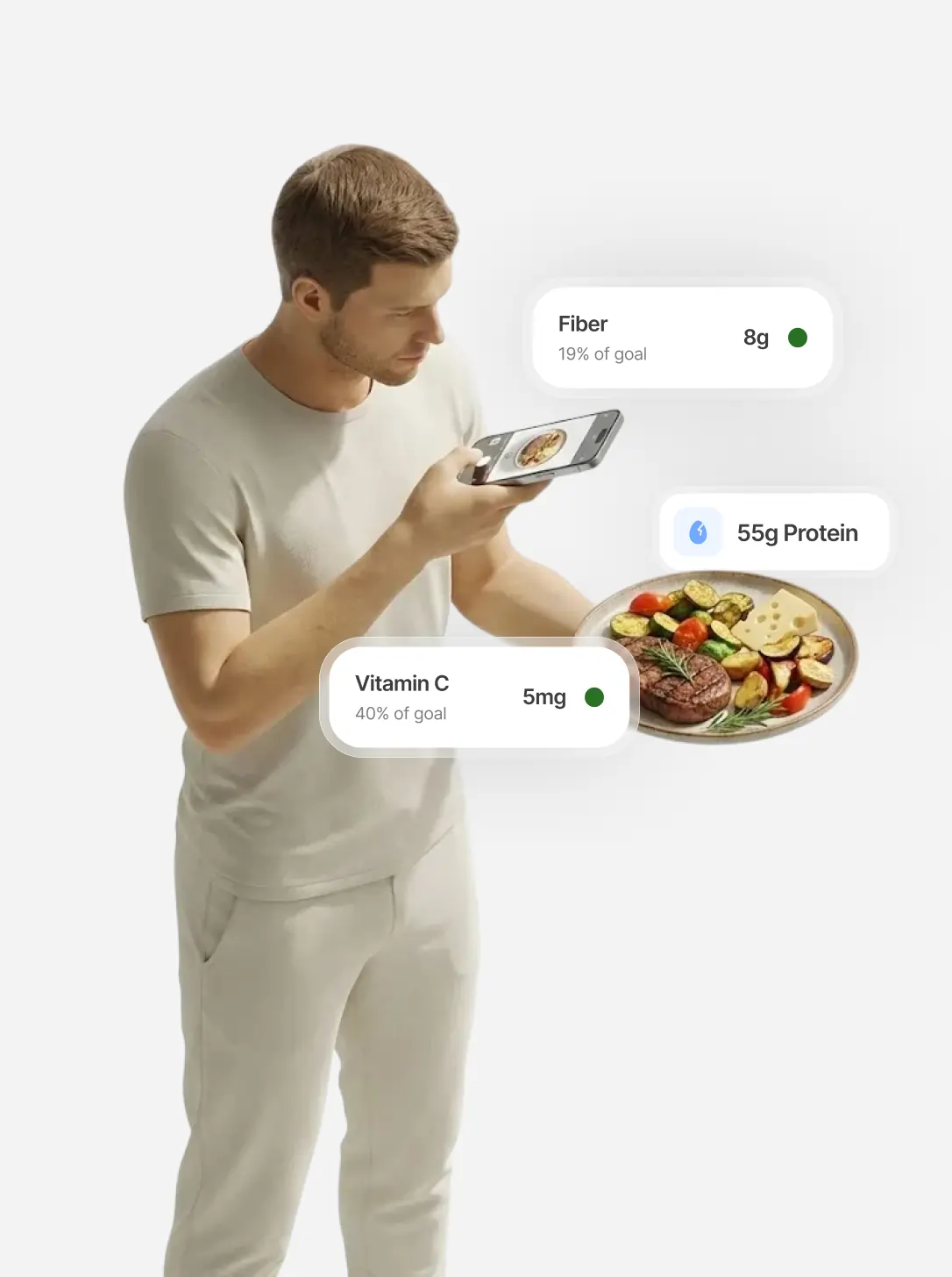
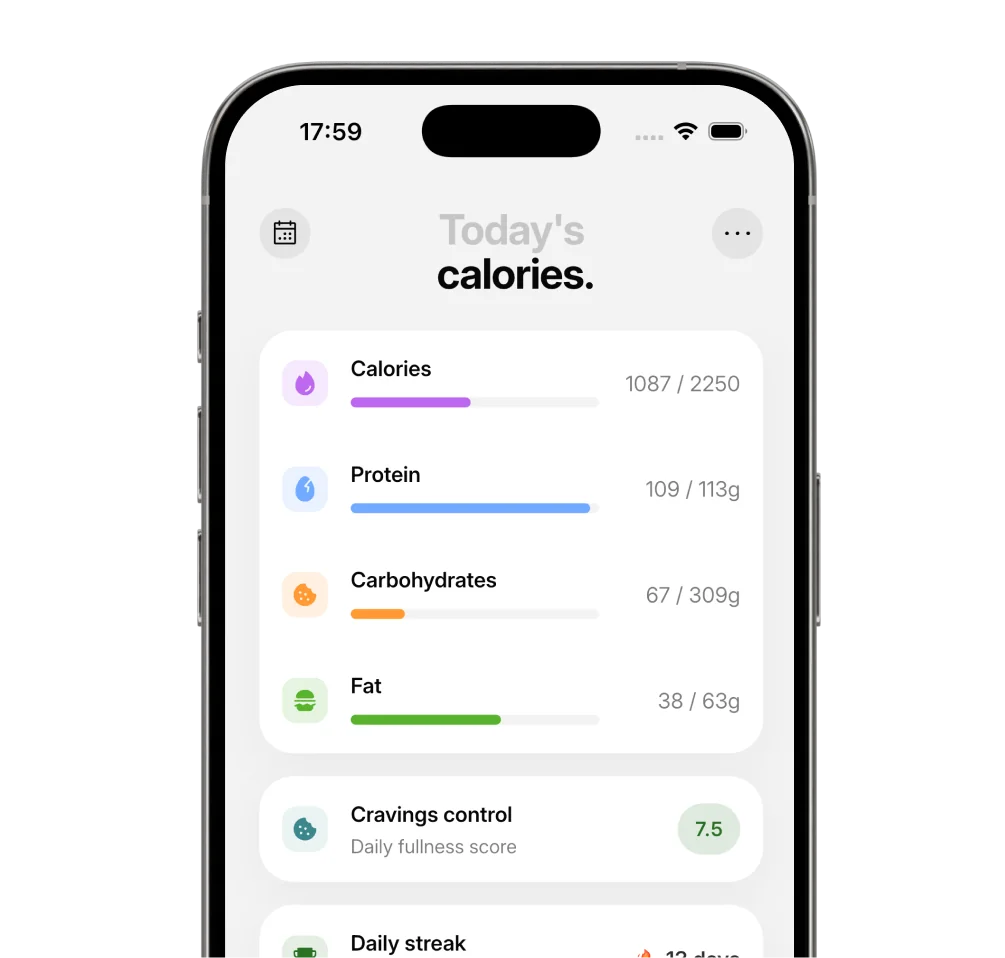
IntakeAI estimates calories, macros and 50+ nutrients from a meal photo, barcode, nutrition label or text description, and shows what you've eaten against your daily targets.
Heads-up: when you first open the app, it asks some of the same questions as this calculator (sex, age, height, weight, activity and goal) to build your plan, plus a few about your diet and how you feel. Its default macro split differs from this page, so if you'd rather use these numbers, you can edit your calorie and macro targets on your plan screen.


How many calories should I eat a day?
Estimate your resting energy with the Mifflin-St Jeor equation, multiply it by an activity factor to get your maintenance calories, then eat about 250–1,000 kcal a day less to lose 0.5–2 lb a week, or a modest amount more to gain. Keep any deficit to about 25% of maintenance at most. Treat the number as a starting point: after 2–4 weeks, compare your weekly average weight with the pace you expected and adjust by 100–200 kcal.
Macros come after calories. Set protein by body weight, set fat as a share of calories, and give the rest to carbs. The sections below explain each step, the research behind it, and how to actually hit your numbers day to day.
Key takeaways
- Maintenance calories are your resting energy (BMR) multiplied by an activity factor between 1.2 and 1.725.
- A 2005 systematic review found Mifflin-St Jeor predicted resting energy within 10% of measured values for more people than other common equations, but it is still an estimate.
- The calculator caps deficits at 25% of maintenance and won't go below 1,200 kcal for women or 1,500 kcal for men.
- Protein is set at 1.4–1.6 g per kg of body weight depending on your goal; fat is 25% of calories, carbs fill the rest, and fiber is 14 g per 1,000 kcal.
- Recheck after 2–4 weeks of weekly averages, and recalculate after every 3–5 kg change.
- A target only works alongside a reasonably accurate food log; in a 24-week study, how often people logged was linked to weight loss, not how long they spent logging.
How the calculator works
The calculator follows five steps. The "See the maths" panel under your results shows each one with your own numbers.
- Resting energy (BMR). The
Mifflin-St Jeor equation,
developed in 1990 from measurements of 498 healthy adults aged 19 to 78, estimates the
energy you burn at rest:
- Men: 10 × weight (kg) + 6.25 × height (cm) − 5 × age (years) + 5
- Women: 10 × weight (kg) + 6.25 × height (cm) − 5 × age (years) − 161
- Prefer not to say: the average of the two, which means − 78 at the end
- Maintenance (TDEE). BMR is multiplied by an activity factor to estimate total daily energy expenditure, the calories that keep your weight stable.
- Goal adjustment. To lose or gain, the calculator subtracts or adds 500 kcal a day for each pound a week of change (3,500 kcal ÷ 7 days).
- Safety limits. A deficit is capped at 25% of maintenance and a surplus at 20%. The target never goes below 1,200 kcal for women, 1,500 kcal for men or 1,350 kcal (the midpoint) for "prefer not to say".
- Rounding. The final target is rounded to the nearest 50 kcal.
| Activity level | What it means | Multiplier |
|---|---|---|
| Sedentary | Desk job, little exercise | 1.2 |
| Lightly active | Exercise 1–3 days a week | 1.375 |
| Moderately active | Exercise 3–5 days a week | 1.55 |
| Very active | Exercise 6–7 days a week | 1.725 |
| Weekly pace | Daily deficit or surplus |
|---|---|
| 0.5 lb (0.23 kg) | 250 kcal |
| 1 lb (0.45 kg) | 500 kcal |
| 1.5 lb (0.68 kg) | 750 kcal |
| 2 lb (0.91 kg) | 1,000 kcal |
The minimums come from the 2013 AHA/ACC/TOS guideline for adults with overweight or obesity, which describes calorie targets of usually 1,200–1,500 kcal a day for women and 1,500–1,800 kcal for men, or a deficit of 500–750 kcal a day. The calculator uses the bottom of those ranges. If your numbers point lower, talk to a doctor or registered dietitian.
How your macros are set
Total calories drive weight change. In a two-year NEJM trial, reduced-calorie diets with different shares of fat, protein and carbohydrate produced similar weight loss. The split still matters for fullness, training and keeping muscle, so the calculator sets it in this order:
- Protein by body weight. A 2015 review in the American Journal of Clinical Nutrition concluded that 1.2–1.6 g per kg a day, with about 25–30 g per meal, improves appetite and weight management, and that higher-protein diets helped preserve lean mass during calorie restriction. A meta-analysis of 49 trials found that muscle gains from resistance training levelled off at about 1.6 g per kg a day. Protein is capped at 35% of calories, the top of the adult range in the Dietary Guidelines for Americans.
- Fat at 25% of calories, inside the guidelines' adult range of 20–35%.
- Carbs get the remaining calories.
- Fiber at 14 g per 1,000 kcal, the Dietary Guidelines' benchmark.
| Goal | Protein | Why this amount |
|---|---|---|
| Lose weight | 1.6 g per kg | Top of the 1.2–1.6 g/kg range, to support fullness and help keep muscle in a deficit |
| Maintain | 1.4 g per kg | Middle of the 1.2–1.6 g/kg range |
| Gain weight | 1.6 g per kg | Where gains from resistance training levelled off in the meta-analysis |
If you carry a lot of excess weight, grams per kg of total body weight can overstate what you need, which is why the 35% cap exists. Basing protein on your goal weight is a sensible alternative. If you prefer fewer carbs, move some carb calories to fat and keep protein the same. For meal ideas that hit high protein and fiber targets, see our high-protein, high-fiber meals for fat loss.
Worked example
A 35-year-old woman, 168 cm tall, weighing 77 kg, lightly active, who wants to lose 1 lb a week:
| Step | Calculation | Result |
|---|---|---|
| Resting energy (BMR) | 10 × 77 + 6.25 × 168 − 5 × 35 − 161 | 1,484 kcal |
| Maintenance (TDEE) | 1,484 × 1.375 | 2,041 kcal |
| Deficit | 1 lb a week × 500 | −500 kcal |
| Safety limits | 25% cap allows down to 1,530 kcal; 1,200 kcal minimum | Neither applies |
| Daily calorie target | 1,541 rounded to the nearest 50 | 1,550 kcal |
| Protein | 1.6 g × 77 kg | 123 g (32%) |
| Fat | 25% of 1,550 kcal ÷ 9 | 43 g (25%) |
| Carbs | Remaining 671 kcal ÷ 4 | 168 g (43%) |
| Fiber | 14 g × 1.55 | 22 g |
Her protein works out to about 31–41 g per meal across 3–4 meals, in line with the 25–30 g minimum per meal from the protein review above.
Track against your targets
How accurate is the result?
It is a reasonable starting estimate, not a measurement. A 2005 systematic review of the four most commonly used equations found Mifflin-St Jeor was the most reliable, predicting resting energy within 10% of measured values in more people with and without obesity than any other equation. The same review noted that errors can still be meaningful for individuals, and that older adults and US ethnic minorities were underrepresented in the research.
The weekly pace is an approximation too. The "3,500 kcal per pound" rule behind it overestimates long-term weight loss, because your energy needs fall as you get lighter. A 2011 Lancet modelling paper estimated it takes about a year to get halfway to a new stable weight after a lasting change in intake. The NIH's Body Weight Planner models this slowdown if you want a longer-range forecast.
In practice: follow your target for 2–4 weeks, weigh yourself under the same conditions a few times a week, and compare weekly averages. If the trend is slower or faster than expected, change intake by 100–200 kcal. Rerun the calculator after every 3–5 kg change. Our guide to adjusting calories when you plateau walks through this step by step.
How to actually hit your targets
Every adjustment above depends on knowing roughly what you eat. A calorie target only works when you compare it with a reasonably accurate food log, check the trend every week or two, and update the target as your weight changes.
Guessing is less reliable than it feels. In a 1992 NEJM study of 10 adults who said they could not lose weight on under 1,200 kcal a day, participants underreported what they ate by an average of 47%. It was a small, specific group, but portions, cooking oil, drinks and snacks are easy for anyone to miss.
Logging often seems to matter more than logging for long. In a 24-week online weight-loss program with 142 adults, people who lost at least 5% of their weight opened their food journal more times a day (2.4 vs 1.6) but did not spend more total time logging. Average logging time fell from about 23 minutes a day in the first month to about 15 by the sixth. That points to quick, frequent logging as the habit worth building.
The manual way
- Read labels and weigh food on a kitchen scale at each meal
- Add up calories, protein, carbs and fat in a spreadsheet or notebook
- Compare each day with the targets from this calculator
- Come back and rerun the calculator after every 3–5 kg change
This works and costs nothing, but it takes time. Our guide to why people quit calorie tracking covers the common sticking points and how to get past them.
With IntakeAI
IntakeAI is an iPhone and Android nutrition app designed to help you reduce cravings. It estimates calories, macros and 50+ nutrients from a meal photo, barcode, nutrition label or text description. It covers the same steps as the manual way:
- The same starting maths. Your calorie target comes from the same Mifflin-St Jeor equation, activity levels and 0.5–2 lb a week pace options as this calculator, with the deficit capped at 25% of maintenance.
- Faster logging. Take a photo, scan a barcode or nutrition label, or type what you ate, instead of looking up every ingredient by hand.
- Progress against your targets. Calories, protein, carbs and fat eaten so far are shown against your daily targets, so you can see what's left for the day.
- Targets that follow your weight. When you update your weight or goal, your calorie target is recalculated.
- Fullness, not just calories. Each meal gets a 0–10 Cravings control score that estimates how filling it is likely to be.
Photo estimates can misjudge portion size or miss cooking oil, so review each result and edit the portion when it looks off. All figures are estimates.
Frequently asked questions
How many calories should I eat to lose weight?
Work out your maintenance calories (Mifflin-St Jeor resting energy multiplied by an activity factor), then eat about 250 to 1,000 kcal a day less to lose roughly 0.5 to 2 lb a week. Keep the deficit to no more than about 25% of maintenance. This calculator also won't suggest less than 1,200 kcal a day for women or 1,500 kcal for men, the low end of the calorie ranges in the 2013 AHA/ACC/TOS obesity guideline. For example, a lightly active 35-year-old woman who is 168 cm tall and weighs 77 kg has an estimated maintenance of about 2,040 kcal, so a target for losing 1 lb a week is about 1,550 kcal.
What is the best macro split for weight loss?
There isn't one best split. In a two-year trial comparing reduced-calorie diets with different amounts of fat, protein and carbohydrate, weight loss was similar across the diets. A practical approach is to set protein first at about 1.2 to 1.6 g per kg of body weight, keep fat between 20% and 35% of calories, and give the rest to carbs. Higher protein mainly helps with fullness and with keeping muscle while you lose weight.
How accurate is this calorie calculator?
It gives an estimate, not a measurement. In a 2005 systematic review, the Mifflin-St Jeor equation predicted resting energy within 10% of measured values for more people than the other common equations, but some individuals fall outside that range, and older adults and some ethnic groups were underrepresented in the research. Use the result as a starting point, then adjust by 100 to 200 kcal after 2 to 4 weeks based on your weekly average weight.
Should I eat back the calories I burn exercising?
Not if the activity level you chose already includes your regular workouts. The activity factor is how this calculator accounts for exercise, so adding workout calories on top counts them twice. If you chose sedentary and then do an unusually long or hard session, your needs that day are higher than your target suggests.
Why won't the calculator go below 1,200 or 1,500 calories?
The 2013 AHA/ACC/TOS guideline for adults with overweight or obesity describes calorie targets of usually 1,200 to 1,500 kcal a day for women and 1,500 to 1,800 kcal for men. This calculator uses the low end of those ranges as its minimum. If your estimate points lower, for example because you are small and not very active, talk to a doctor or registered dietitian before eating less.
Does the IntakeAI app use the same calculation?
The calorie part is very similar. IntakeAI uses the same Mifflin-St Jeor equation, the same four activity levels, a weekly pace of 0.5 to 2 lb and a deficit capped at 25% of maintenance. When you first open the app, it asks some of the same questions as this calculator (sex, age, height, weight, activity level and goal) to build your plan. The app applies its own default macro split and calorie limits, so the plan it suggests can differ from this page, and you can edit your calorie and macro targets on your plan screen.
Related guides
How to Adjust Calories When You Plateau (Step by Step)
What to check and change when your weekly average stops moving.
READ MORE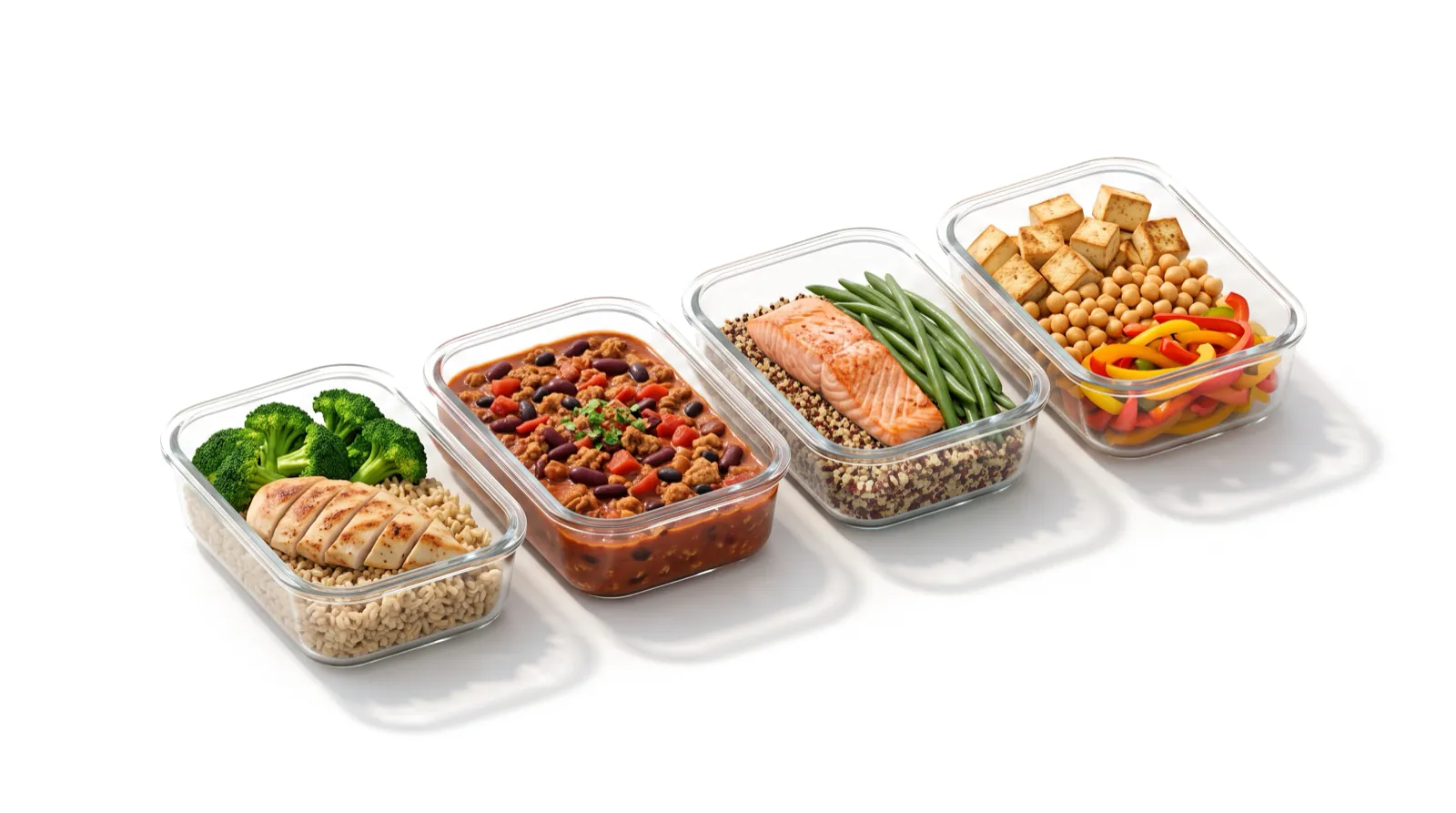
High Protein, High Fiber Meals for Fat Loss: 14 Ideas
Meals that make your protein and fiber targets easier to hit.
READ MORE
Track Macros by Taking a Picture of Your Food
How photo logging works, where it goes wrong, and how to check it.
READ MOREHit your targets without weighing every meal
IntakeAI sets a personalised calorie target from the Mifflin-St Jeor equation, your activity level and your goal pace. Log meals by photo, barcode or text and see calories, protein, carbs and fat against your targets.
Sources
- Mifflin MD, St Jeor ST, Hill LA, Scott BJ, Daugherty SA, Koh YO (1990). A new predictive equation for resting energy expenditure in healthy individuals. American Journal of Clinical Nutrition, 51(2), 241–247. PubMed
- Frankenfield D, Roth-Yousey L, Compher C (2005). Comparison of predictive equations for resting metabolic rate in healthy nonobese and obese adults: a systematic review. Journal of the American Dietetic Association, 105(5), 775–789. PubMed
- Jensen MD, Ryan DH, Apovian CM, Ard JD, et al. (2014). 2013 AHA/ACC/TOS guideline for the management of overweight and obesity in adults. Circulation, 129(25 Suppl 2), S102–S138. PubMed
- Sacks FM, Bray GA, Carey VJ, Smith SR, et al. (2009). Comparison of weight-loss diets with different compositions of fat, protein, and carbohydrates. New England Journal of Medicine, 360(9), 859–873. PubMed
- Leidy HJ, Clifton PM, Astrup A, Wycherley TP, et al. (2015). The role of protein in weight loss and maintenance. American Journal of Clinical Nutrition, 101(6), 1320S–1329S. PubMed
- Morton RW, Murphy KT, McKellar SR, Schoenfeld BJ, et al. (2018). A systematic review, meta-analysis and meta-regression of the effect of protein supplementation on resistance training-induced gains in muscle mass and strength in healthy adults. British Journal of Sports Medicine, 52(6), 376–384. PubMed
- US Department of Agriculture and US Department of Health and Human Services (2020). Dietary Guidelines for Americans, 2020–2025. dietaryguidelines.gov
- Lichtman SW, Pisarska K, Berman ER, et al. (1992). Discrepancy between self-reported and actual caloric intake and exercise in obese subjects. New England Journal of Medicine, 327(27), 1893–1898. PubMed
- Harvey J, Krukowski R, Priest J, West D (2019). Log often, lose more: electronic dietary self-monitoring for weight loss. Obesity, 27(3), 380–384. PubMed
- Thomas DM, Martin CK, Lettieri S, et al. (2013). Can a weight loss of one pound a week be achieved with a 3500-kcal deficit? Commentary on a commonly accepted rule. International Journal of Obesity, 37(12), 1611–1613. PubMed
- Hall KD, Sacks G, Chandramohan D, et al. (2011). Quantification of the effect of energy imbalance on bodyweight. The Lancet, 378(9793), 826–837. PubMed
- National Institute of Diabetes and Digestive and Kidney Diseases. Body Weight Planner. niddk.nih.gov/bwp
This calculator is for general education and is not medical advice. It is designed for healthy adults and is not suitable if you are under 18, pregnant or breastfeeding. If you have a medical condition, an eating disorder or take medication that affects your weight or appetite, speak to a doctor or registered dietitian before changing your diet. All figures are estimates.