How to Track Calories Without Logging Everything Manually

How do you track calories without logging everything manually?
To track calories without logging everything by hand, save the 10–15 meals you eat most and re-log them in one tap, photograph or describe new meals, scan barcodes on packaged food, and log within minutes of eating. Studies suggest logging often matters more than logging in fine detail. Most of the work in traditional calorie counting is searching a database and entering every ingredient. You can skip most of that without losing the benefit, because the benefit comes mainly from the habit of noticing what you eat.
This guide covers the shortcuts that remove the typing, how to get a typical meal logged in under 30 seconds, and where cutting corners stops being worth it.
Key takeaways
- In a 24-week online program of 142 adults, time spent logging fell from 23.2 minutes a day in month 1 to 14.6 minutes in month 6. How often people logged, not how many minutes they spent, separated those who lost at least 5% of their weight.
- In a 16-week trial of 42 adults, people who switched to a shorter food diary sent in more diaries and lost about the same weight (−7.6 kg vs −7.5 kg) as people who kept detailed records.
- Most people eat the same handful of breakfasts, lunches and snacks. Saving them once turns most of your logging into a single tap.
- Logging right after you eat catches the cooking oil, drinks and bites you forget by evening. Recalling the whole day at night is where most entries go missing.
Why logging less detail can still work
Self-monitoring is one of the best-supported habits in weight management. A 2011 systematic review of 22 studies found a consistent link between self-monitoring and weight loss, though the authors called the evidence weak because most studies relied on self-report and mostly enrolled white women. What the research does not show is that the precision of each entry drives that link. Several studies point the other way.
| Study | Who took part | What it found about effort vs. frequency |
|---|---|---|
| Harvey et al., 2019 | 142 adults, 24-week online program | Logging time dropped from 23.2 to 14.6 min/day. People who lost at least 10% opened their food journal about 2.7 times a day vs 1.7 for the rest. Minutes spent did not differ by weight loss. |
| Helsel et al., 2007 | 42 adults, 16 weeks | The abbreviated-diary group returned significantly more diaries. Weight loss was −7.6 kg vs −7.5 kg for detailed diaries among completers. |
| Peterson et al., 2014 | 220 women, 12 months after a weight-loss program | How often and how consistently people logged predicted weight change. How detailed each record was added nothing on top of that. |
These are small studies, and two were mostly women with obesity in structured programs, so don't over-read them. Still, they point the same way. A quick entry made every time you eat beats a perfect entry you skip because it feels like a chore. The Harvey team's own conclusion was that the act of logging regularly, rather than the time or detail put into it, was what tracked with success.
Seven shortcuts that replace manual logging
Each of these removes a specific source of typing. You don't need all of them; pick the ones that match how you eat.
1. Build a repeat-meal library
Write down what you ate over the last two weeks and you will probably find a short rotation: two or three breakfasts, a few go-to lunches, the same snacks. Log each of those carefully once, with real portions, and save it as a meal. After that, the bulk of your week is a single tap. This is the biggest time-saver available, and it works in almost any tracker.
2. Re-log from your recent meals
Leftovers, the same order at the same café, the yogurt you have every afternoon: a "recent" list catches all of these without you having to save anything. If a meal turns up in your recents three times, promote it to your saved library.
3. Photograph mixed plates
For a plate with several components, such as a stir-fry, a salad bowl or a restaurant main, a photo is faster than searching for each ingredient. The trade-off is accuracy on portion size and hidden fats; a 2023 systematic review of 52 studies found AI calorie estimates had average relative errors anywhere from 0.1% to 38%, with smaller errors for simple, single-food images. Treat photo estimates as a starting point and check the portion. Our guide to tracking calories from a photo goes deeper on getting good estimates.
4. Scan barcodes for anything in a package
Packaged food carries its own nutrition label, so scanning it is usually the most reliable entry you will make. The only judgement call is how much of the package you ate. For when to reach for each method, see barcode scanner vs. photo tracking.
5. Describe it in one sentence
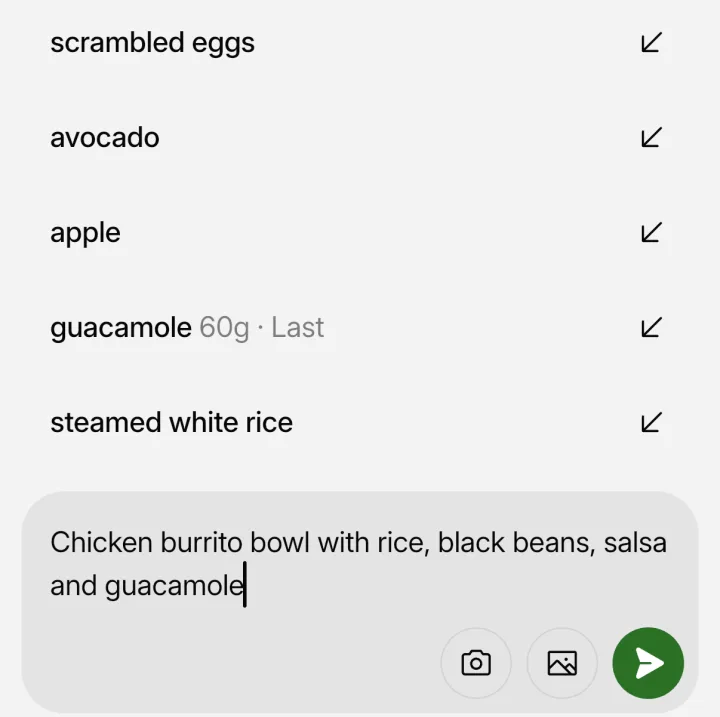
"Two scrambled eggs, one slice of sourdough with butter, black coffee" is quicker to type than three separate searches, and it works when a photo would not help, such as a meal you already finished.
6. Log the base, then add the extras
The calories people miss are rarely the main food. They are the tablespoon of oil in the pan, the dressing, the milk in coffee and the handful of nuts. Make a habit of a two-second check: "Was anything cooked in fat or poured on top?" If yes, add it.
7. Log home recipes once, per portion
If you batch-cook chili or overnight oats, enter the whole recipe once and divide it into portions. Every later serving becomes a repeat meal.
Track calories & nutrients fast


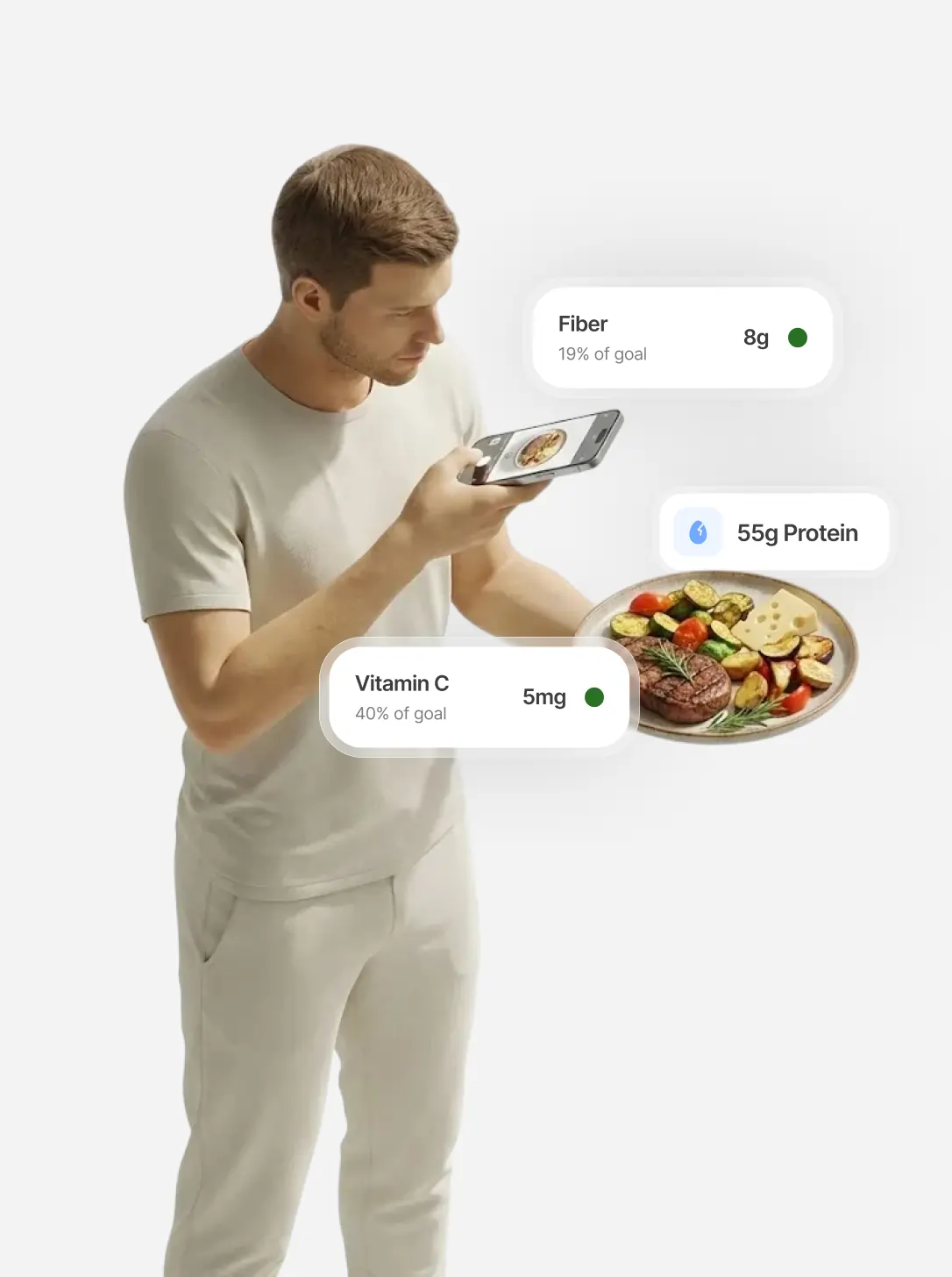
Log as you go or recall it at night?
End-of-day recall feels efficient because you do it in one sitting, but it depends on memory. The things that slip are exactly the ones that add up: a second coffee with milk, a biscuit in a meeting, the oil in a stir-fry. Logging within a few minutes of eating is quicker per entry too, because the meal is still in front of you (or in your camera roll).
If you genuinely can't log in the moment, take a photo of everything you eat and process the photos later. That keeps the record honest without interrupting the meal. Patterns from the Harvey study also support spreading entries through the day: the most successful group opened their journal more than twice a day on average, rather than once at night.
How to make food logging take less than 30 seconds
Once your repeat meals are saved, this routine handles almost any meal quickly:
- Check your saved and recent meals first. If the meal is there, log it and you're done. For most people this covers most meals.
- If it's packaged, scan the barcode and set the amount you actually ate.
- If it's a new plate, take one photo from slightly above, with the whole plate in frame.
- Glance at the portion. If the estimate looks off (for example, the rice looks like one cup but you served two), fix it.
- Add the hidden extras: oil, butter, sauce, dressing, a sugary drink.
- Save it if you'll eat it again. Thirty extra seconds now saves minutes over the month.
For situations where you have no scale or packaging at all, our guide to tracking calories without weighing food covers hand-portion and visual estimates.
When it's worth slowing down
Low-effort logging is good enough for most goals, but there are times to be more careful. If your weight hasn't moved for several weeks while you log consistently, a few days of careful logging (weighing calorie-dense foods such as oils, nuts, cheese and cereal) will show you whether your quick entries are drifting. The same applies if a dietitian has set you specific targets for a medical condition. Use the detailed approach as an occasional check, not as your everyday routine.
Doing it manually vs. with an app
You can apply every shortcut above with a notes app and a nutrition database: keep a list of your repeat meals with their calories, copy them into each day, and only look up what's new. It works, and it costs nothing, but you still do the adding up and you only see calories and whichever macros you bother to write down.
An app does the arithmetic and remembers your meals for you. IntakeAI is an iPhone and Android nutrition app designed to help you reduce cravings. It estimates calories, macros and 50+ nutrients from a photo, a barcode, a nutrition-label scan or a typed description. You can re-log recent meals, search foods backed by the USDA FoodData Central database, and edit the portion or swap out a food when the AI's guess is wrong. Photo estimates can miss oil or misjudge portion size, so the "glance at the portion" step above still applies.
Whichever tool you use, the goal is the same: make each entry small enough that you never skip one. If you're still choosing a method, the easiest way to track calories, macros and nutrients compares the options side by side. If logging has already started to feel like a chore, read why most people quit calorie tracking.
Frequently asked questions
Can you track calories without logging every single food?
Yes. Saving the meals you eat repeatedly, re-logging recent meals, scanning barcodes and photographing new plates removes most manual entry. Small studies suggest how often and how consistently you log predicts results better than how detailed each entry is, so a quick entry for every meal is a sound approach.
How can I make food logging take less than 30 seconds?
Check your saved and recent meals first, scan a barcode for packaged food, or take one photo of a new plate. Then glance at the portion, add any oil, sauce or drink, and save the meal if you will eat it again. Most of the speed comes from building a library of repeat meals.
Is it better to log meals right away or at the end of the day?
Right away, when you can. End-of-day recall depends on memory and tends to miss snacks, drinks and cooking fats. If you cannot log in the moment, photograph what you eat and log from the photos later.
Are photo calorie estimates accurate enough?
They are a useful starting point but not exact. A 2023 systematic review found AI calorie estimates ranged from very close to about 38% off, with better accuracy for simple single-food images. Check the portion size and add hidden fats such as oil or dressing.
Do I need a food scale to track calories?
No. A scale helps for occasional accuracy checks, especially for calorie-dense foods like oil, nuts and cheese, but day-to-day logging with saved meals, barcodes, photos and visual portion estimates is enough for most people.
Related guides
The Easiest Way to Track Calories, Macros and Nutrients
Compare tracking methods and pick the one you will actually keep using.
READ MORE
Track Calories From a Photo With AI Food Tracking
How photo estimates work and how to get better results from them.
READ MORE
Why Most People Quit Calorie Tracking (and How to Make It Stick)
What the data says about tracking drop-off and a plan to keep going.
READ MORELog your next meal in seconds
Snap a photo, scan a barcode or type what you ate, then re-log your regular meals with a tap. IntakeAI fills in calories, macros and 50+ nutrients, and you can edit any portion.
Sources
- Burke LE, Wang J, Sevick MA (2011). Self-monitoring in weight loss: a systematic review of the literature. Journal of the American Dietetic Association. PubMed
- Harvey J, Krukowski R, Priest J, West D (2019). Log often, lose more: electronic dietary self-monitoring for weight loss. Obesity. PubMed
- Helsel DL, Jakicic JM, Otto AD (2007). Comparison of techniques for self-monitoring eating and exercise behaviors on weight loss in a correspondence-based intervention. Journal of the American Dietetic Association. PubMed
- Peterson ND, Middleton KR, Nackers LM, et al. (2014). Dietary self-monitoring and long-term success with weight management. Obesity. PubMed
- Shonkoff E, Cara KC, Pei XA, et al. (2023). AI-based digital image dietary assessment methods compared to humans and ground truth: a systematic review. Annals of Medicine. PubMed
This article is for general education and is not medical advice. If you have a medical condition, an eating disorder, are pregnant, or take medication, speak to a doctor or registered dietitian before changing your diet. IntakeAI's nutrition figures and scores are estimates to guide your choices.