Best Way to Track Calories Without Weighing Food
What is the best way to track calories without weighing food?
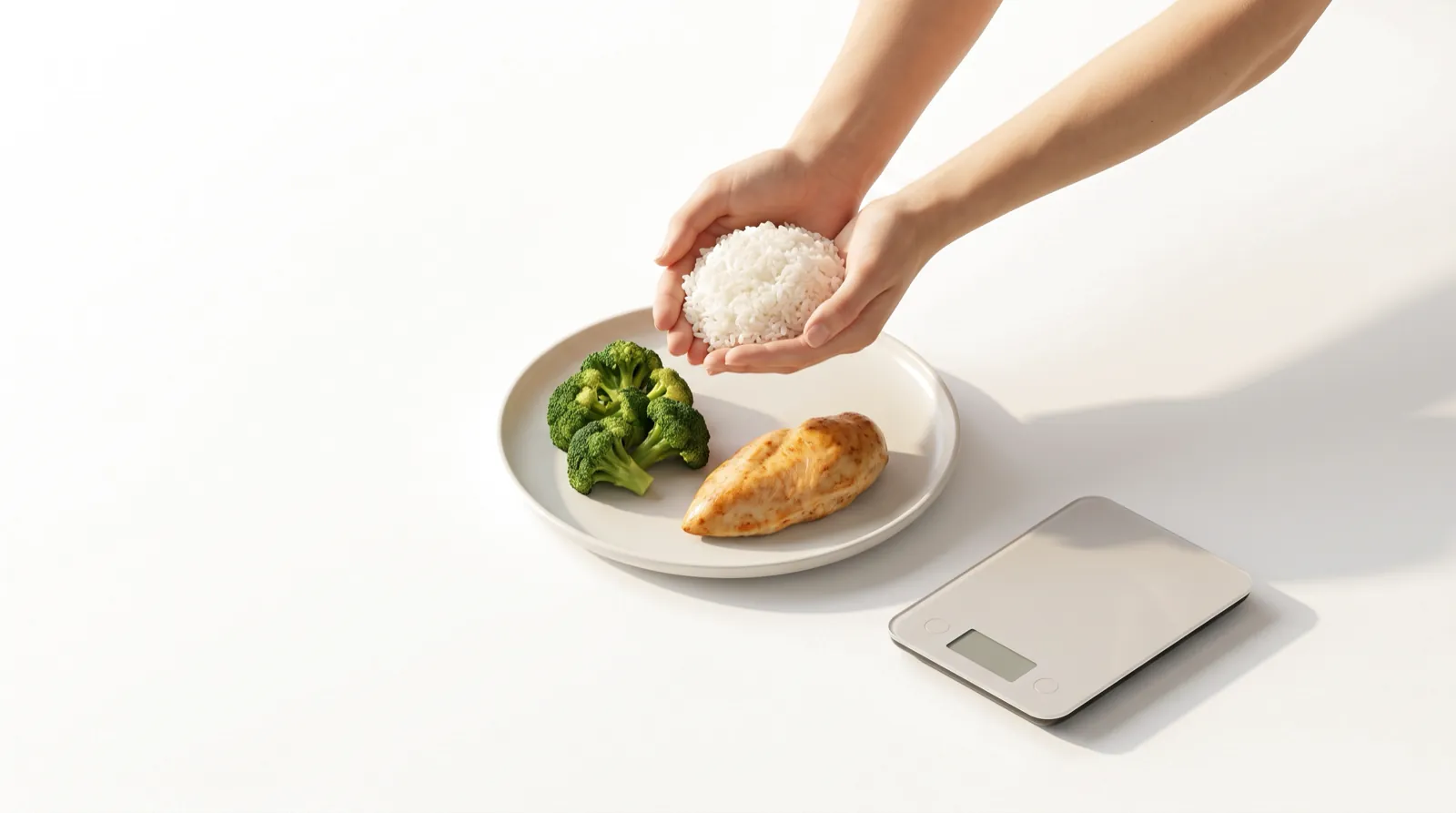
The best way to track calories without weighing food is to log every meal with hand portions or a photo, then measure only the calorie-dense extras, such as oil, butter, nut butter and dressing, which carry roughly 100–120 kcal per tablespoon. Lean protein, grains and vegetables forgive a rough guess. Fats do not: a "splash" of olive oil that is really three tablespoons adds about 360 kcal. If you estimate the big items by eye and control the small, dense ones, you can keep a useful food log without ever owning a scale.
This guide gives you a hand-portion chart with real gram and calorie figures, explains where visual estimates usually go wrong, and covers the few situations where weighing is still worth the effort.
Key takeaways
- A palm of cooked chicken breast (about 100 g) is roughly 165 kcal; a fist of cooked rice (about 160 g) is roughly 210 kcal.
- In a study of 67 adults, 80% of finger-width estimates of geometrically shaped foods landed within ±25% of the true weight, versus 29% for cups and spoons.
- People underestimate big meals the most: fast-food diners undercounted their meals by an average of 175 kcal, and the gap widened as meal size grew.
- Measure oils, butter, nut butters and dressings with a spoon even if you never weigh anything else.
- A one- to two-week weighing "calibration" period, or weighing during a plateau, gives most of the benefit of a scale without the daily hassle.
Why tracking without a scale still works
Food logging helps because it makes intake visible, not because every gram is right. A systematic review of 22 weight-loss studies found a consistent link between self-monitoring and weight loss, though the authors rated the evidence as weak because most studies were observational and relied on self-report.
How often you log seems to matter more than how carefully. In a 24-week online program with 142 adults, people who lost at least 5% of their body weight opened their food journal more often each day (2.4 vs 1.6 times). Minutes spent logging didn't differ between the groups, and it fell from about 23 minutes a day in month one to about 15 minutes by month six. Weighing every meal is the step most likely to make you skip a log, so a method you will repeat at every meal is the better trade.
The catch is that estimates tend to drift low. In a well-known NEJM study, ten people who reported they could not lose weight on under 1,200 kcal a day were found to underreport their intake by an average of 47%. That was a small, specific group, but it shows why a scale-free method needs some guardrails, which the rest of this guide gives you.
Hand-portion guide: palm, fist, cupped hand and thumb
Your hand is a measuring tool you always have with you, and it scales roughly with body size. The table below converts common hand measures into grams and calories. Calories come from per-100 g values in USDA FoodData Central; gram weights are typical for an average adult hand, so treat them as starting points rather than exact values.
| Hand measure | Roughly equals | Example food | Approx. weight | Approx. calories |
|---|---|---|---|---|
| Palm (no fingers, palm thickness) | 3–4 oz cooked protein | Roast chicken breast | 100 g | 165 kcal |
| Palm | 3–4 oz cooked protein | Salmon, farmed, cooked | 100 g | 206 kcal |
| Palm | 3–4 oz cooked protein | Ground beef 85% lean, cooked | 100 g | 256 kcal |
| Fist | About 1 cup | Cooked white rice | 160 g | 208 kcal |
| Fist | About 1 cup | Cooked pasta | 140 g | 221 kcal |
| Fist | About 1 cup | Boiled broccoli | 90 g | 32 kcal |
| Cupped hand | About 1 oz | Almonds | 30 g | 174 kcal |
| Thumb (tip to base) | About 1 tbsp | Peanut butter | 16 g | 96 kcal |
| Thumb | About 1 tbsp | Olive oil | 13.5 g | 119 kcal |
| Thumb | About 1 tbsp | Butter | 14 g | 100 kcal |
How well do hands work? In a 2016 University of Sydney study, 67 adults estimated 42 pre-weighed foods and drinks. When they used their finger widths as a ruler on foods with simple shapes, 80% of estimates fell within ±25% of the true weight, compared with 29% when they used household cups and spoons. Precision was still limited (only 13% were within ±10%), and irregular foods such as salads or pasta are harder. Hand portions get you in the right range. They are not a replacement for a scale when you need exact numbers.
How to log a meal using hand portions
- Split the plate into parts. Protein, starch, vegetables, and anything added (sauce, oil, cheese, dressing).
- Size each part with your hand. Palms for meat, fish, tofu or eggs; fists for rice, pasta, potatoes, cereal or fruit; cupped hands for nuts, dried fruit or chips; thumbs for fats and spreads.
- Check how it was cooked. Fried, sautéed or roasted with oil means adding at least one thumb of fat per serving unless you know otherwise.
- Log the closest database match in grams. "Chicken breast, roasted, 100 g" is more accurate than "1 chicken breast," which varies widely in size.
- Round up when unsure. Because estimates tend to run low, picking the larger of two plausible portions usually lands closer to the truth.
Track calories & nutrients fast


How accurate is eyeballing portion sizes?
Less accurate than most people think, and the error isn't random. In a BMJ study of 1,877 adults leaving US fast-food chains, the average meal contained 836 kcal and diners underestimated it by 175 kcal on average. Underestimation grew substantially as the actual calorie content of the meal rose. Small meals were guessed reasonably well; large ones were not.
Judging food from a picture is no easier. In an online study of 2,028 people who estimated calories for 20 food photos with known values, the average person got only 5 of 20 within 20% of the true figure, and so did the five nutrition experts used as a benchmark. Calorie-dense foods tended to be overestimated in that study, which shows that the direction of the error depends on the food and the setting, even though the size of the error is consistently large.
Where scale-free estimates usually go wrong
- Cooking fat. Oil soaks into vegetables, rice and meat and is invisible on the plate. One tablespoon of olive oil is about 119 kcal.
- Large or second servings. The bigger the plate, the bigger the miss, so log refills as separate entries.
- Dense "small" foods. Peanut butter, cheese and nuts pack roughly 400–600 kcal per 100 g, so a heaped spoon or a generous handful adds up fast.
- Liquid calories. Juice, milky coffee, smoothies and alcohol rarely fit a hand measure. Use the container size or a measuring cup.
- Mixed dishes. Casseroles, curries and stir-fries hide their oil and cheese. Log the components if you cooked it, or the closest whole-dish entry if you didn't.
Restaurant food makes all five problems worse. Our guide on how to track calories when eating out covers menu labels and hidden restaurant fats in detail.
When is weighing food still worth it?
A scale is a tool for specific jobs, not a lifelong requirement. Weighing earns its place when:
- You are calibrating your eye. Weigh your usual breakfast bowl, rice portion and pour of oil for one or two weeks. After that, your hand and eye estimates tend to be closer to reality.
- The food is calorie-dense. Nut butters, oils, cheese, cereal and nuts are where a few grams make a real difference. Weighing just these covers most of the error.
- Progress has stalled for several weeks. Before cutting calories further, a short weighing check often reveals portions that have quietly grown. See how to adjust calories when you plateau.
- You need precision for a reason. Physique competitions, some sports, or a diet prescribed by a clinician may require gram-level accuracy.
Weighing is not worth it if it makes eating stressful or obsessive. If tracking of any kind triggers anxiety, rigid rules or binge-restrict cycles, pause and talk to a doctor or registered dietitian, ideally one experienced with eating disorders.
Hand portions on paper vs using an app
Everything above works with a notebook and the free USDA database: size each item by hand, look up the per-100 g value, multiply, and add up the day. It's a good skill to have, but doing the arithmetic for every meal is exactly the kind of friction that makes people stop logging.
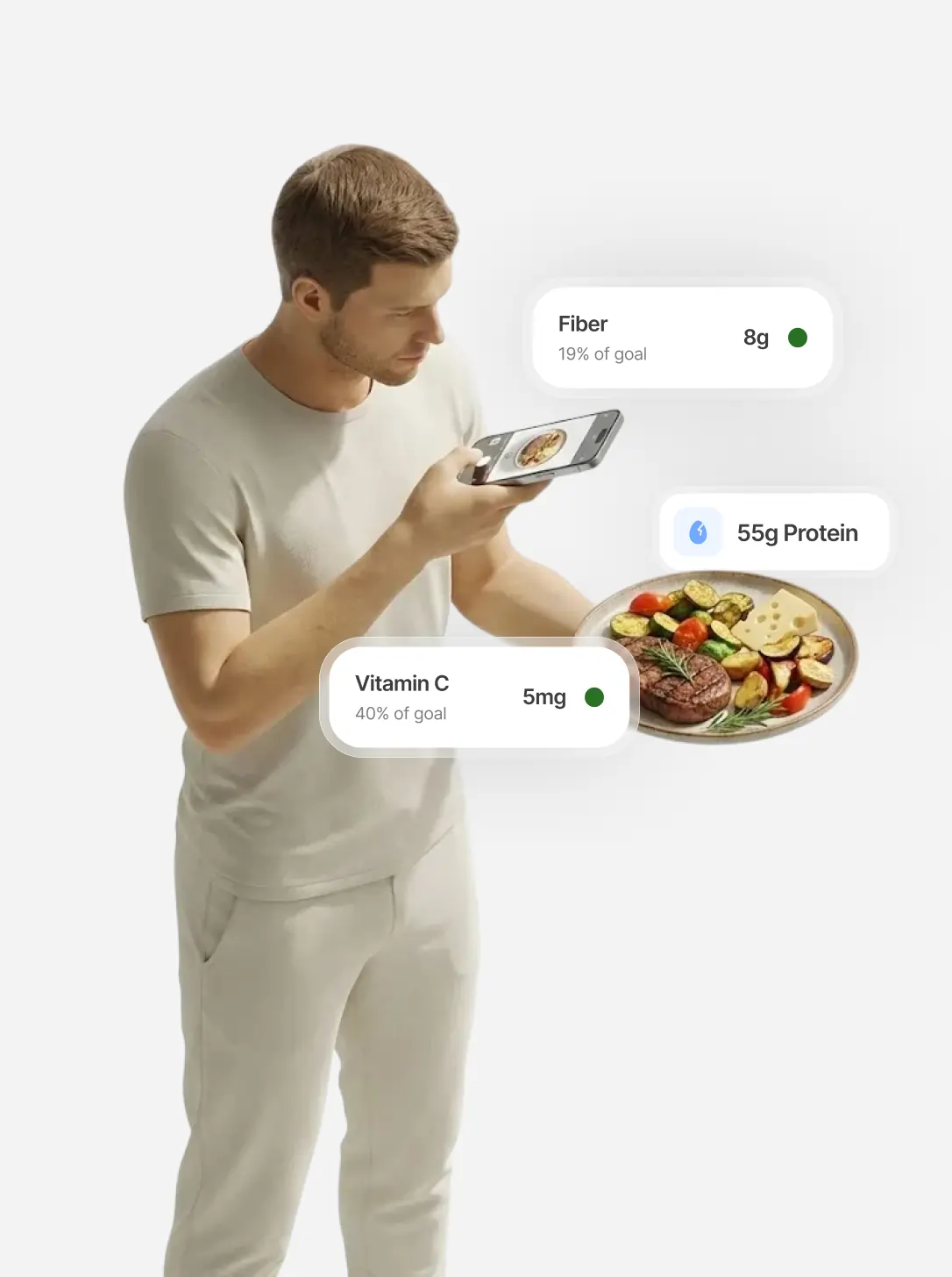
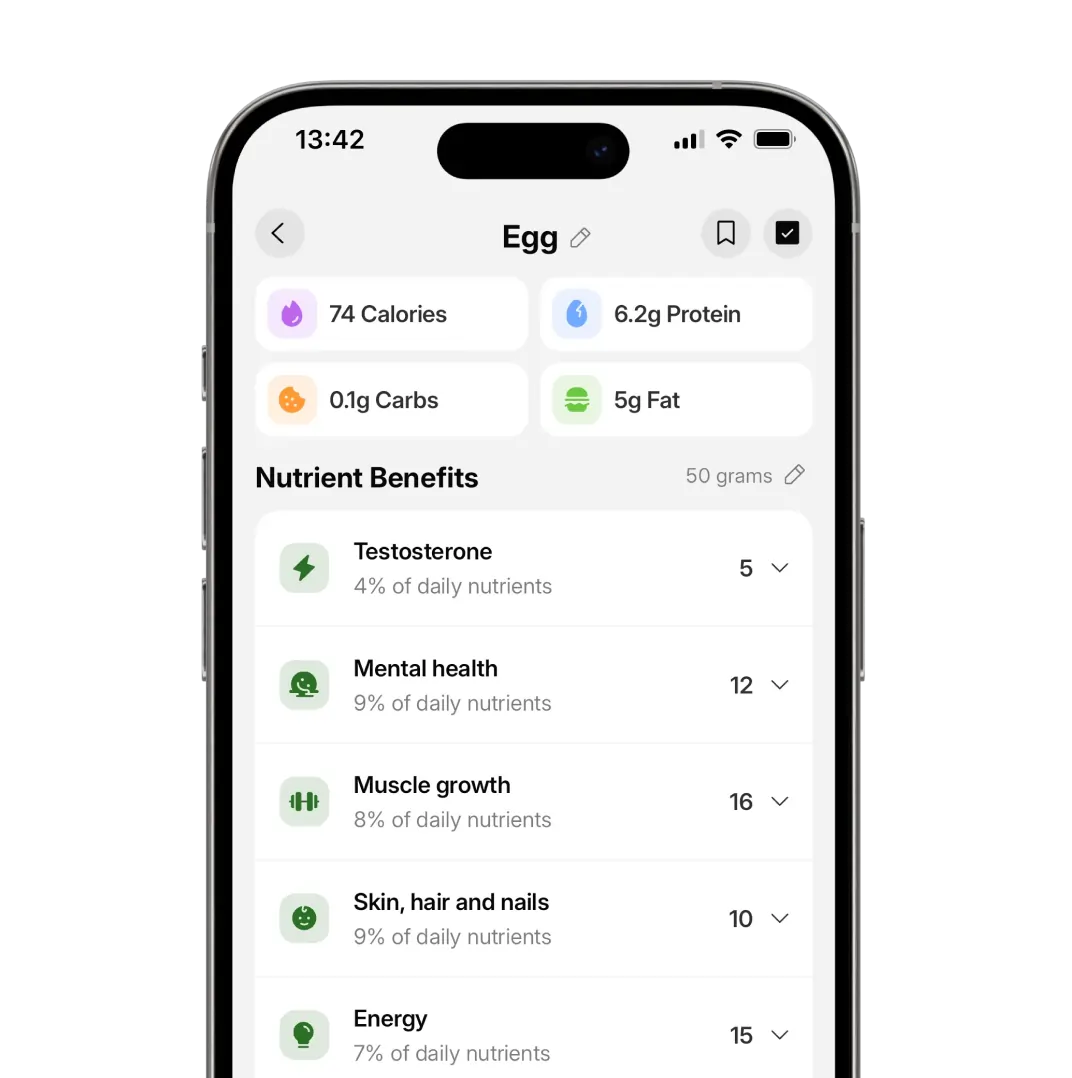
A photo-based tracker replaces that arithmetic. IntakeAI is an iPhone and Android nutrition app designed to help you reduce cravings. It estimates calories, macros and more than 50 nutrients from a meal photo, a barcode or a typed description. You take a picture (or pick one from your gallery), it identifies the foods and suggests a weight for each, and you can change those grams when your hand-portion check says otherwise. You can also add a short note such as "cooked in two tablespoons of butter" so hidden fat is included. The estimates can still be wrong on portion size or hidden oil, which is why the editable weights matter.
If you want to understand what happens between the photo and the number, read how AI photo calorie tracking works. For the bigger picture on choosing a tracking method you will actually keep using, start with our guide to the easiest way to track calories, macros and nutrients.
Frequently asked questions
Can you count calories accurately without a food scale?
You can count calories accurately enough to guide weight loss without a scale. In one study, finger-width estimates of simple-shaped foods were within 25% of the true weight 80% of the time. Measuring oils, butter and nut butters with a spoon removes much of the remaining error.
How many calories is a palm-sized portion of chicken?
A palm-sized portion of roast chicken breast is about 100 g cooked, which is roughly 165 kcal and 31 g of protein based on USDA FoodData Central values. Larger hands or thicker cuts can be 150 g or more.
What foods should you always measure?
Always measure calorie-dense foods where small amounts add up: cooking oil (about 119 kcal per tablespoon), butter, peanut butter, nuts, cheese, granola and salad dressing. A tablespoon or measuring cup is enough; you do not need a scale for these.
Is it better to weigh food raw or cooked?
Either works as long as you log the matching database entry. Raw and cooked weights differ a lot because meat loses water and rice and pasta absorb it, so 100 g of raw rice and 100 g of cooked rice have very different calories.
Do people underestimate or overestimate portion sizes?
Most people underestimate, especially for large meals. In a BMJ study of 1,877 adults at fast-food chains, diners underestimated their meals by 175 kcal on average, and the gap grew as meals got bigger.
Related guides
The Easiest Way to Track Calories, Macros and Nutrients
Compare every tracking method and find the one you will actually stick with.
READ MORE
How to Track Calories When Eating Out
Menu labels, hidden oils and quick estimates for meals you did not cook.
READ MORE
Track Calories From a Photo: How AI Food Tracking Works
What photo calorie counters do well, where they struggle and how to get better results.
READ MORESkip the scale, keep the log
IntakeAI estimates calories, macros and 50+ nutrients from a photo, barcode or text description, and lets you edit every portion in grams.
Sources
- Burke LE, Wang J, Sevick MA (2011). Self-monitoring in weight loss: a systematic review of the literature. J Am Diet Assoc. PubMed
- Harvey J, Krukowski R, Priest J, West D (2019). Log often, lose more: electronic dietary self-monitoring for weight loss. Obesity. PubMed
- Lichtman SW et al. (1992). Discrepancy between self-reported and actual caloric intake and exercise in obese subjects. N Engl J Med. PubMed
- Gibson AA et al. (2016). Accuracy of hands v. household measures as portion size estimation aids. J Nutr Sci. PubMed
- Block JP et al. (2013). Consumers' estimation of calorie content at fast food restaurants: cross sectional observational study. BMJ. PubMed
- Zhou J et al. (2018). Calorie estimation from pictures of food: crowdsourcing study. Interact J Med Res. PubMed
- U.S. Department of Agriculture, Agricultural Research Service. FoodData Central (SR Legacy entries for roasted chicken breast, farmed salmon, 85% lean ground beef, cooked white rice, cooked pasta, boiled broccoli, almonds, smooth peanut butter, olive oil, salted butter). fdc.nal.usda.gov
This article is for general education and is not medical advice. If you have a medical condition, an eating disorder, are pregnant, or take medication, speak to a doctor or registered dietitian before changing your diet. IntakeAI's nutrition figures and scores are estimates to guide your choices.