How to Manage Cravings When Dieting (and Stay in a Deficit)

How do you manage cravings when dieting?
Manage cravings on a diet by keeping the calorie deficit moderate, eating about 30% of calories from protein, filling up on high-volume foods and budgeting planned portions of the foods you love instead of banning them. Reassuringly, a meta-analysis of 8 studies found cravings usually fall during 12+ weeks of calorie restriction. The harder part is often hunger, which can rise as you lose weight — so the plan needs to handle both.
This guide separates those two problems. Cravings — the urge for a specific food — tend to fade the longer you stick with a sensible diet. Hunger — the physical drive to eat — is shaped by hormones that shift as body weight drops. Each has its own fix, and mixing them up is a common reason people give up in the first few weeks.
Key takeaways
- Calorie restriction of at least 12 weeks reduced overall cravings and cravings for sweet, high-fat, starchy and fast foods in a 2017 meta-analysis.
- In a 2-year trial of 270 adults, people craved less of whichever food type their diet restricted — carbs on low-carb, fatty foods on low-fat.
- Weight loss raises the hunger hormone ghrelin: after a 13.5 kg loss, levels and hunger were still elevated a year later in 50 adults.
- Raising protein from 15% to 30% of calories cut spontaneous intake by about 441 kcal a day in a 19-person study.
- Flexible dieting (planned portions, no strict bans) is linked with less binge eating and better weight-loss success than rigid all-or-nothing rules.
Do cravings get worse when you diet?
Most people expect cutting calories to make cravings unbearable. The longer-term evidence mostly says the opposite. A 2017 systematic review and meta-analysis pooled eight studies of people with obesity who followed calorie restriction for at least 12 weeks. Overall cravings decreased, as did cravings for sweets, high-fat foods, starches and fast food. The authors interpret this as a "de-conditioning" effect: when you eat a food less often, the learned link between cues and that food weakens.
A 2-year randomized trial of 270 adults with obesity points the same way. Those assigned to a low-carbohydrate diet had larger drops in cravings for carbohydrates and starches; those on a low-fat diet had larger drops in cravings for high-fat foods. In other words, people craved less of what they were eating less of. And in an online survey of 2,932 members of a commercial weight-loss program, those actively dieting reported fewer, less intense cravings than those just trying not to gain, and cravings decreased further as they lost weight over 7 weeks.
The exception: the first days and strict bans
The picture can look different in the short term. In a 3-day experiment, people told to cut out complex carbohydrates reported more carbohydrate cravings and ate more of a high-carb food afterwards; those cutting animal protein craved more protein foods. So cravings can spike early on, especially for anything you have just declared off-limits. If the first two weeks are hard, that does not mean the diet will stay this hard.
What changes during a diet: the evidence at a glance
| Study | Who and how long | What changed |
|---|---|---|
| Kahathuduwa et al. 2017 (meta-analysis) | 8 studies, adults with obesity, ≥12 weeks of calorie restriction | Cravings fell overall (effect −0.25) and most for sweets (−0.41) |
| Martin et al. 2011 | 270 adults, low-carb vs low-fat, 2 years | Cravings fell most for the food type each diet restricted |
| Coelho et al. 2006 | Adults, 3 days of cutting carbs or animal protein | Short-term cravings rose for the restricted food type |
| Sumithran et al. 2011 | 50 adults, 10-week very-low-energy diet, followed to 62 weeks | Ghrelin and hunger higher than baseline, even a year later |
| Weigle et al. 2005 | 19 adults, protein raised from 15% to 30% of calories | Spontaneous intake down 441 kcal/day; 4.9 kg lost over 12 weeks |
Effect sizes in the first row are standardized pooled differences, not points on a scale. Most of these studies involved people with obesity and, in several, mainly women, so they may not apply equally to everyone.
The real challenge: hunger on a calorie deficit
While cravings tend to ease, your body does push back. In a landmark NEJM study, 50 adults with overweight or obesity lost an average of 13.5 kg on a 10-week very-low-energy diet. Levels of ghrelin, the hormone that rises before meals, went up, and so did subjective appetite. At 62 weeks, ghrelin and hunger were still above where they started. That was an aggressive diet, but the direction applies to most weight loss: the more you lose, the more your appetite tries to win it back.
This is why "just ignore hunger" fails over months. If you are unsure whether what you feel at night is hunger or a craving, our cravings vs hunger checklist will help you respond correctly.
The best way to reduce hunger on a calorie deficit
- Prioritize protein. In a University of Washington study, 19 adults who moved from 15% to 30% protein while keeping carbohydrates the same ate about 441 kcal a day less without being told to, and lost 4.9 kg over 12 weeks — even though their ghrelin rose. Spread it across meals: roughly 25–40 g each.
- Lower the energy density of your plate. Research summarized by Barbara Rolls shows people tend to eat a fairly consistent weight of food, so swapping in water-rich foods (vegetables, fruit, soups, salads) lets you eat the same volume for fewer calories. Our list of foods that reduce cravings and keep you full has specific swaps.
- Keep the deficit moderate. A smaller deficit means a smaller appetite response day to day. Losing fat slowly is still losing fat.
- Sleep. Short sleep raises next-day intake; see how to control cravings without willpower for the numbers.
Track calories & nutrients fast


Flexible vs rigid restraint: why "no treats ever" backfires
How you restrict matters as much as how much. Psychologists distinguish rigid restraint (all-or-nothing rules, banned foods, "I've ruined today, so I might as well keep going") from flexible restraint (smaller portions, planned treats, compensating gradually).
In a German validation study that included questionnaires and food diaries from 54,517 people in a weight-reduction program and a population sample of 1,838, flexible control was associated with less frequent and less severe binge eating, lower BMI, lower reported intake and a higher chance of successful weight loss over the one-year program. Rigid control was linked to more binge eating. A study of 188 women similarly found rigid dieting, but not flexible dieting, was associated with eating-disorder symptoms and mood disturbance. Both studies are correlational, so they cannot prove that one style causes the other, but they match what an older review of food restriction described: strict restriction is linked to preoccupation with food and binges once food is available.
The commercial-program survey above adds a practical twist: it was not how often people craved but whether they ate in response that predicted weight change. A flexible plan gives you a planned, measured way to respond.
A craving-proof plan for your next deficit
- Set a moderate target. Estimate your maintenance calories and aim for a deficit you could live with for months, not a crash diet.
- Anchor every meal with protein. Decide your protein source first, then build the rest of the plate.
- Add volume before you cut. Add a vegetable side or broth-based soup to lunch and dinner before you reduce portions of anything else.
- Budget a daily treat. Set aside a fixed allowance, such as 100–200 kcal, for the food you crave most, and eat it on purpose, from a plate.
- Replace bans with "not in the house". Keep foods you can't stop eating out of the cupboard, and enjoy them when you are out, in a single serving.
- Plan for the first two weeks. Expect cravings to peak early and fade. Write down your two or three hardest moments and what you will do instead.
- Review weekly, not hourly. One big meal does not undo a week. Look at the weekly average and adjust.
If your weight loss stalls after several weeks, rather than cutting harder, read our guide on losing weight without feeling hungry, which shows how to rebuild meals so the deficit feels smaller.
Running the plan: by hand or with an app
You can do all of this with a food scale, nutrition labels and a spreadsheet: calculate your maintenance calories, log what you eat, add up protein per meal and keep a running total for your treat budget. It is accurate if you are consistent, and many people do it successfully for a few weeks before the admin wears thin.
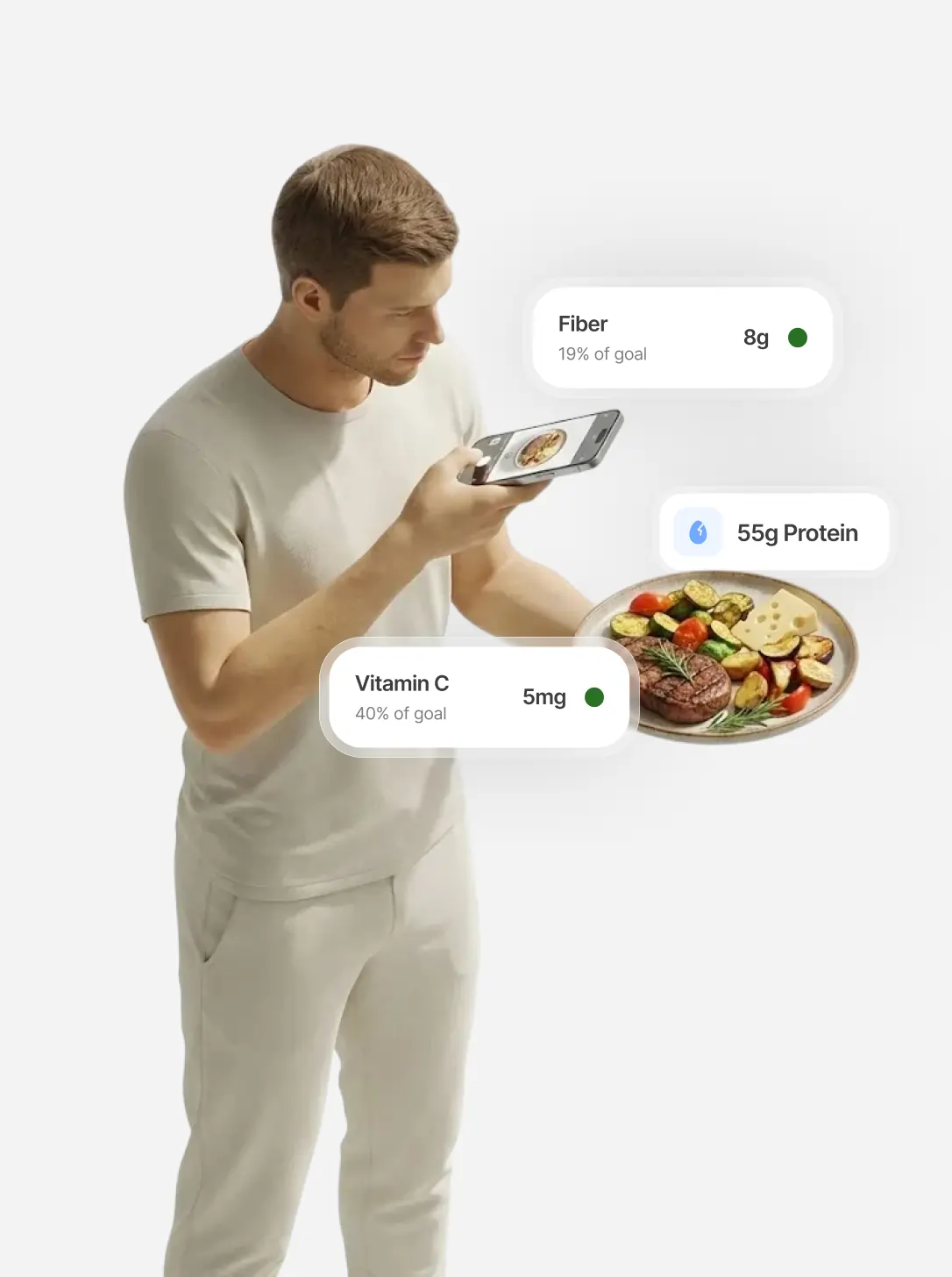
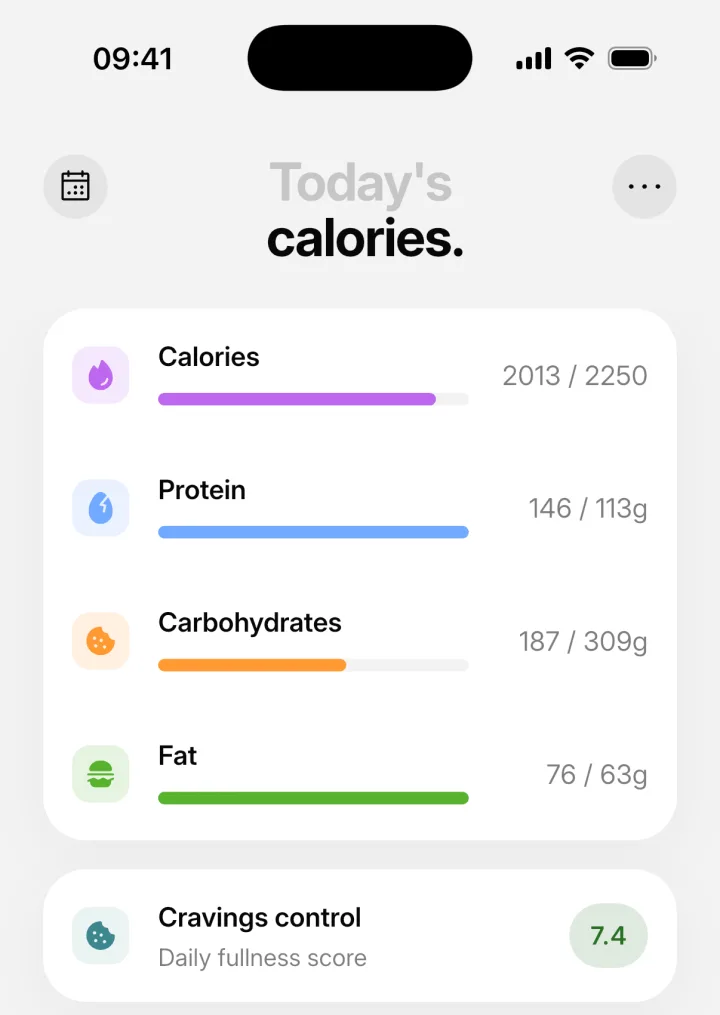
IntakeAI covers the same steps with less typing. It is a calorie and nutrition tracking app for iPhone and Android that estimates calories, macros and 50+ nutrients from a meal photo, barcode, label scan or written description. Your calorie target is calculated from your BMR (Mifflin-St Jeor) and activity level, adjusted for the pace you choose between 0.5 and 2 lb a week, with the deficit capped at 25% of your daily energy needs to keep it from getting too aggressive. Each meal also gets a 0–10 Cravings control score from its protein, fiber, calorie density, processing level and other factors, which is a quick guide to whether a meal is likely to keep you full — an estimate, not a promise.
Eating less food can also make it harder to hit vitamin and mineral targets. IntakeAI's "Fix your deficiencies" view suggests foods that fill today's or this week's nutrient gaps. As with any photo-based estimate, portion sizes and cooking oils can be misjudged, so check the result and edit the weight when needed.
When to get professional support
Dieting is not right for everyone. If you have a history of an eating disorder, regularly eat large amounts while feeling out of control (see the NHS page on binge eating disorder), are pregnant, have diabetes, or take appetite-changing medication such as a GLP-1 drug, plan your approach with a doctor or registered dietitian. For a broader look at why cravings build up in the first place, see our main guide on how to reduce food cravings and food noise.
Frequently asked questions
Do cravings go away when you diet?
They often decrease rather than increase. A 2017 meta-analysis of 8 studies found overall cravings, and cravings for sweet, high-fat, starchy and fast foods, fell during calorie restriction lasting at least 12 weeks. Cravings can still spike in the first days, especially for foods you have just banned.
What is the best way to reduce hunger on a calorie deficit?
Eat more protein, fill your plate with water-rich, lower-energy-density foods like vegetables, fruit and soups, keep the deficit moderate, and sleep enough. In one study, raising protein from 15% to 30% of calories reduced spontaneous intake by about 441 kcal a day.
Why am I hungrier after losing weight?
Weight loss changes appetite hormones. In a study of 50 adults who lost an average of 13.5 kg, ghrelin and hunger rose and were still above baseline a year later. Planning higher-protein, higher-volume meals helps you handle this rather than relying on willpower.
Should I cut out my favorite foods when dieting?
Usually not completely. Flexible dieting, with planned portions and no strict bans, is associated with less binge eating and better weight-loss success than rigid rules. Keeping a small daily treat budget is a practical way to do this.
How big should my calorie deficit be to avoid cravings?
A moderate deficit you can sustain for months is easier on appetite than a crash diet. IntakeAI, for example, caps its calculated deficit at 25% of your daily energy needs. If you have a medical condition, agree a target with a doctor or dietitian.
Related guides

How to Reduce Food Cravings and Food Noise
The main guide: why cravings and constant food thoughts build up, and the meal-level changes that quiet them.
READ MORE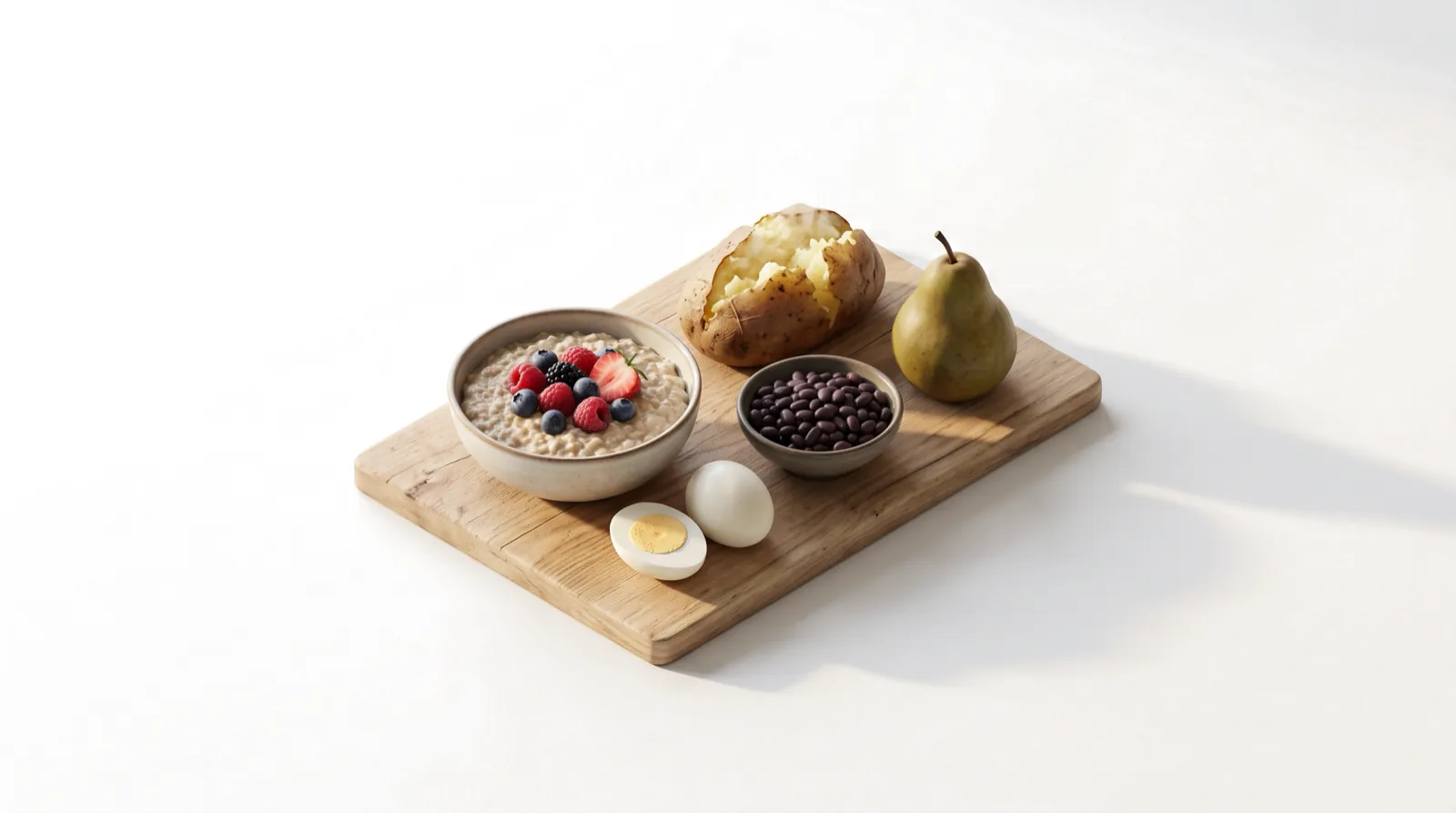
Foods That Reduce Cravings and Keep You Full
Specific high-protein, high-fiber and high-volume foods that make a calorie deficit easier to live with.
READ MORE
Cravings vs Hunger: How to Tell the Difference
A side-by-side comparison and a quick checklist to work out whether you need food or something else.
READ MORESet a deficit that doesn't fight your appetite
IntakeAI calculates a personal calorie target, estimates each meal's calories, protein and 50+ nutrients from a photo or description, and gives it a Cravings control score you can chart over time.
Sources
- Kahathuduwa CN, Binks M, Martin CK, Dawson JA (2017). Extended calorie restriction suppresses overall and specific food cravings: a systematic review and a meta-analysis. Obesity Reviews, 18(10), 1122–1135. PubMed
- Martin CK, Rosenbaum D, Han H, et al. (2011). Change in food cravings, food preferences, and appetite during a low-carbohydrate and low-fat diet. Obesity, 19(10), 1963–1970. PubMed
- Smithson EF, Hill AJ (2017). It is not how much you crave but what you do with it that counts: behavioural responses to food craving during weight management. European Journal of Clinical Nutrition, 71(5), 625–630. PubMed
- Coelho JS, Polivy J, Herman CP (2006). Selective carbohydrate or protein restriction: effects on subsequent food intake and cravings. Appetite, 47(3), 352–360. PubMed
- Sumithran P, Prendergast LA, Delbridge E, et al. (2011). Long-term persistence of hormonal adaptations to weight loss. New England Journal of Medicine, 365(17), 1597–1604. PubMed
- Weigle DS, Breen PA, Matthys CC, et al. (2005). A high-protein diet induces sustained reductions in appetite, ad libitum caloric intake, and body weight despite compensatory changes in diurnal plasma leptin and ghrelin concentrations. American Journal of Clinical Nutrition, 82(1), 41–48. PubMed
- Rolls BJ (2009). The relationship between dietary energy density and energy intake. Physiology & Behavior, 97(5), 609–615. PubMed
- Westenhoefer J, Stunkard AJ, Pudel V (1999). Validation of the flexible and rigid control dimensions of dietary restraint. International Journal of Eating Disorders, 26(1), 53–64. PubMed
- Stewart TM, Williamson DA, White MA (2002). Rigid vs. flexible dieting: association with eating disorder symptoms in nonobese women. Appetite, 38(1), 39–44. PubMed
- Polivy J (1996). Psychological consequences of food restriction. Journal of the American Dietetic Association, 96(6), 589–592. PubMed
This article is for general education and is not medical advice. If you have a medical condition, an eating disorder, are pregnant, or take medication, speak to a doctor or registered dietitian before changing your diet. IntakeAI's nutrition figures and scores are estimates to guide your choices.