Why Diets Fail Because of Cravings (Not a Lack of Discipline)

Why do diets fail because of cravings?
Diets usually fail because weight loss makes the body push back: appetite hormones shift toward hunger, one NIH analysis estimated about 100 extra calories a day of drive to eat for every kilogram lost, and a food environment full of hyper-palatable options turns that drive into cravings. Discipline matters less than most people think. When a plan fights biology and surroundings at the same time, the cravings eventually win, and the person blames themselves.
This article explains the four forces behind diet failure (appetite adaptation, metabolic adaptation, the food environment and overly rigid rules) and what people who keep weight off for years actually do differently.
Key takeaways
- In a 2011 NEJM study, hunger and the hunger hormone ghrelin were still elevated 62 weeks after people lost an average of 13.5 kg.
- Appetite appears to push back about three times harder than metabolism: roughly 100 kcal/day per kg lost, according to one modelling study.
- Metabolic adaptation is real but usually modest; "starvation mode" that stops fat loss is a myth.
- Flexible restraint is linked to better weight maintenance than rigid, all-or-nothing dieting.
- Long-term maintainers in the National Weight Control Registry stay active, self-monitor, and eat consistently across the week.
What happens to your appetite after you lose weight?
Your body regulates fat stores partly through hormones from fat tissue and the gut. When fat mass falls, those signals change in a direction that favors eating more. The clearest long-term evidence comes from a 2011 study in the New England Journal of Medicine. Fifty adults with overweight or obesity followed a 10-week very-low-energy diet and lost an average of 13.5 kg. Compared with baseline, leptin, peptide YY and cholecystokinin (signals linked to fullness) fell, while ghrelin (linked to hunger) and self-reported appetite rose. At 62 weeks, most of these differences, including higher hunger, were still present.
That study used a rapid, very-low-calorie diet, so the size of the effect may be larger than with a moderate deficit. But a 2016 NIH analysis reached a similar conclusion by a different route. Using data from 153 people in a year-long drug trial, where weight loss happened without people being aware of a calorie deficit, researchers estimated that appetite increased by about 100 kcal a day for every kilogram lost, more than three times the matching drop in energy expenditure. It is a model-based estimate, but it explains a common experience: the further you get from your starting weight, the louder food becomes.
This is also why cravings are not simply hunger. Our guide on how to tell cravings from hunger covers the difference in more detail.
How much does metabolism really slow down?
Energy expenditure falls during a diet for two reasons. First, a smaller body needs less energy to run and move. Second, there is adaptive thermogenesis: an additional drop beyond what the change in body size predicts. In their review of adaptive thermogenesis, Rosenbaum and Leibel describe this as a coordinated defense of body fat that involves metabolic, hormonal and behavioral responses, with leptin playing a central role.
The size of the effect is where online claims go wrong. Here is what specific studies measured:
| Study | Who and how much weight lost | Measured adaptation |
|---|---|---|
| MATADOR, 2018 | Men with obesity, 16 weeks at 67% of maintenance needs; continuous group lost ~9 kg | Resting energy expenditure about 749 kJ (~180 kcal) a day lower than body composition predicted in the continuous-diet group; about 360 kJ (~85 kcal) in the group that took diet breaks |
| Biggest Loser follow-up, 2016 | 14 contestants who lost ~58 kg in 30 weeks of extreme diet and exercise | About 499 kcal a day of metabolic adaptation, still present 6 years later |
| Polidori et al., 2016 | 153 people losing weight over 52 weeks (modelled) | Appetite increase about 3 times larger than the energy expenditure adaptation |
So adaptation is real, and it is larger with faster, more extreme weight loss. For a typical moderate diet, it is more likely to be in the tens to low hundreds of calories per day. That can slow progress, which is why plateaus happen (see how to adjust calories when you plateau), but it does not stop fat loss or put the body into "starvation mode." The bigger problem for most people is the extra appetite that comes with it.
Track calories & nutrients fast



How does the food environment make cravings worse?
Appetite adaptation would be easier to manage in a world where food took effort to get. Instead, hyper-palatable food is cheap, close and heavily marketed. In a 2019 analysis of a US food database, 62% of 7,757 foods met at least one research definition of hyper-palatable, meaning combinations such as fat with sugar or fat with salt that make food easy to keep eating.
Processing appears to add to this. In a controlled NIH inpatient trial, 20 adults ate an ultra-processed diet and an unprocessed diet for two weeks each, eating as much as they wanted. On the ultra-processed diet they ate about 500 kcal a day more and gained weight; on the unprocessed diet they lost weight. The study was small and short, but it showed that the type of food, not just willpower, can change how much people eat.
Put a person with rising appetite into that environment and cravings are predictable. A diet that relies on resisting the same tempting foods every day, without changing what is around you or what you eat at meals, sets up a contest that biology tends to win.
Why do rigid, restrictive diets backfire?
Many diets fail not because they are too lenient but because they are too strict. Researchers distinguish between rigid restraint (all-or-nothing rules, forbidden foods, "I've blown it" thinking) and flexible restraint (moderate limits, planned treats, adjusting the next meal instead of giving up). In a study of 106 women maintaining weight loss, flexible restraint was associated with more weight lost and better maintenance over six months, while rigid restraint was associated with less weight loss and greater attention to food and body-shape cues.
That fits a familiar pattern: a very low calorie target during the week, mounting hunger, then a weekend of overeating that feels like failure. Our guide on staying in a calorie deficit without bingeing covers this cycle in depth. You may also see claims that willpower is a finite resource that "runs out." The evidence for that idea (ego depletion) is mixed, so it is more useful to think of evening cravings as the result of hunger, fatigue and easy access to food than of a depleted willpower tank.
What do people who keep weight off actually do?
The National Weight Control Registry follows adults who have lost at least 30 lb (13.6 kg) and kept it off for at least a year. According to a 2005 summary by Wing and Phelan, members had lost an average of 33 kg and kept it off for more than five years. The most common habits they reported were:
- About an hour a day of physical activity
- A lower-calorie, lower-fat diet
- Eating breakfast regularly
- Weighing themselves regularly
- Eating consistently on weekdays and weekends
A 10-year follow-up of 2,886 members found that more than 87% were estimated to still be maintaining at least a 10% weight loss at years 5 and 10. Regain was associated with less leisure-time activity, less dietary restraint, less frequent self-weighing, a higher share of calories from fat, and more disinhibited eating. The registry is self-selected and relies on self-reported data, so it describes what successful people do rather than proving those habits cause success. Still, the pattern is consistent: maintainers keep doing the things that made the loss work, and they do them steadily rather than perfectly.
A craving-aware plan, in six steps
- Choose a moderate deficit. Smaller deficits mean smaller hunger and adaptation responses than crash diets.
- Build meals for fullness. Prioritise protein, fiber and low calorie density at every meal, especially the one before your usual craving time.
- Change the environment. Keep hyper-palatable snacks out of sight or out of the house, and make filling options the easiest choice.
- Plan flexibility. Budget for foods you enjoy instead of banning them.
- Self-monitor. Track food and weight regularly enough to notice drift early.
- Treat maintenance as a phase, not an ending. The appetite changes do not disappear when you reach your goal.
For the full set of hunger-reducing strategies, start with our hub guide on losing weight without feeling hungry.
How to spot which meals set off your cravings
Manually: keep a simple log for two weeks. Write down each meal, its rough protein and fiber, whether it was mostly whole or packaged food, and rate your hunger and cravings two to three hours later on a 0–10 scale. Patterns usually appear fast, such as a light, low-protein lunch followed by a 4 p.m. snack attack.
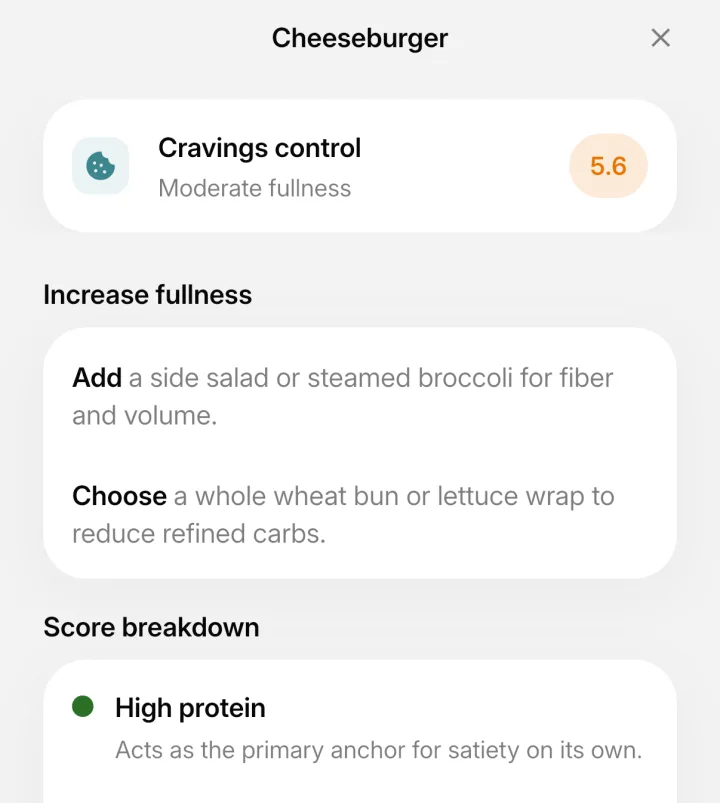
With an app: IntakeAI is an iPhone and Android nutrition app designed to help you reduce cravings. It estimates calories, macros and 50+ nutrients from a photo, barcode, nutrition label or typed description, so the log takes seconds rather than minutes. In IntakeAI, each meal also gets a Cravings control score from 0 to 10 based on protein, fiber, calorie density, hyper-palatability, satiety nutrients and processing level, and you can chart it over time next to your calories. It is an estimate to guide choices, and AI photo estimates can misjudge portions or hidden oil, so edit anything that looks wrong.
If you are caught in repeated cycles of strict dieting and loss-of-control eating, or you feel distressed about food, talk to a doctor or registered dietitian. That pattern can be a sign of binge eating disorder, which is treatable. If you take a GLP-1 medication, ask your prescriber how to set calorie and protein targets alongside it.
Frequently asked questions
Why do most diets fail?
Mainly because the body pushes back. After weight loss, hunger hormones shift in a direction that increases appetite, and these changes were still present a year later in one NEJM study. Combined with an environment full of cheap, hyper-palatable food and diets that are too rigid to sustain, cravings rise until the diet is abandoned. It is a predictable biological and environmental problem, not a character flaw.
Does your metabolism slow down when you diet?
Yes, but usually less than people fear. Energy expenditure falls partly because a smaller body burns less, and partly through adaptive thermogenesis, an extra reduction beyond what weight change predicts. In most diets this extra drop is modest, often in the range of tens to a couple of hundred calories a day. Extreme cases, such as former Biggest Loser contestants, showed around 500 calories a day. Metabolism does not shut down.
Are cravings stronger after you lose weight?
Often, yes. In a study of 50 adults who lost an average of 13.5 kg, the hunger hormone ghrelin and subjective hunger were still higher than baseline 62 weeks later. A separate NIH modelling study estimated that appetite rises by about 100 calories a day for every kilogram lost.
What do people who keep weight off long term do?
In the National Weight Control Registry, people who lost at least 30 lb and kept it off commonly report about an hour of daily physical activity, eating breakfast, weighing themselves regularly, and eating consistently across weekdays and weekends. Over 10 years, falling activity, less self-weighing and more disinhibited eating were linked to regain.
Is a strict diet better than a flexible one?
The evidence favors flexibility. In a study of 106 women maintaining weight loss, flexible restraint was associated with more weight lost and better maintenance, while rigid restraint was associated with less weight loss and more attention to food cues. Planned, moderate approaches tend to be easier to sustain than all-or-nothing rules.
Related guides
How to Lose Weight Without Feeling Hungry All the Time
The hub guide to keeping a calorie deficit without constant hunger.
READ MORE
How to Stay in a Calorie Deficit Without Bingeing
How to break the restrict-then-binge cycle with a moderate deficit and planned flexibility.
READ MORE
How to Adjust Calories When You Plateau
A step-by-step checklist for stalled weight loss, with a worked Mifflin-St Jeor recalculation.
READ MOREMake the diet work with your appetite, not against it
IntakeAI estimates calories and 50+ nutrients from a photo, barcode or text, and scores each meal's Cravings control from 0 to 10 so you can see which meals keep you fuller. Available on iPhone and Android.
Sources
- Sumithran P, Prendergast LA, Delbridge E, et al. (2011). Long-term persistence of hormonal adaptations to weight loss. New England Journal of Medicine, 365(17), 1597–1604. PubMed
- Polidori D, Sanghvi A, Seeley RJ, Hall KD (2016). How strongly does appetite counter weight loss? Quantification of the feedback control of human energy intake. Obesity, 24(11), 2289–2295. PubMed
- Rosenbaum M, Leibel RL (2010). Adaptive thermogenesis in humans. International Journal of Obesity, 34(Suppl 1), S47–S55. PubMed
- Fothergill E, Guo J, Howard L, et al. (2016). Persistent metabolic adaptation 6 years after "The Biggest Loser" competition. Obesity, 24(8), 1612–1619. PubMed
- Byrne NM, Sainsbury A, King NA, Hills AP, Wood RE (2018). Intermittent energy restriction improves weight loss efficiency in obese men: the MATADOR study. International Journal of Obesity, 42(2), 129–138. PubMed
- Hall KD, Ayuketah A, Brychta R, et al. (2019). Ultra-processed diets cause excess calorie intake and weight gain: an inpatient randomized controlled trial of ad libitum food intake. Cell Metabolism, 30(1), 67–77. PubMed
- Fazzino TL, Rohde K, Sullivan DK (2019). Hyper-palatable foods: development of a quantitative definition and application to the US food system database. Obesity, 27(11), 1761–1768. PubMed
- Westenhoefer J, Engel D, Holst C, et al. (2013). Cognitive and weight-related correlates of flexible and rigid restrained eating behaviour. Eating Behaviors, 14(1), 69–72. PubMed
- Wing RR, Phelan S (2005). Long-term weight loss maintenance. American Journal of Clinical Nutrition, 82(1 Suppl), 222S–225S. PubMed
- Thomas JG, Bond DS, Phelan S, Hill JO, Wing RR (2014). Weight-loss maintenance for 10 years in the National Weight Control Registry. American Journal of Preventive Medicine, 46(1), 17–23. PubMed
This article is for general education and is not medical advice. If you have a medical condition, an eating disorder, are pregnant, or take medication, speak to a doctor or registered dietitian before changing your diet. IntakeAI's nutrition figures and scores are estimates to guide your choices.